I lifted my laptop open without turning on the main light in the office.
Part 2
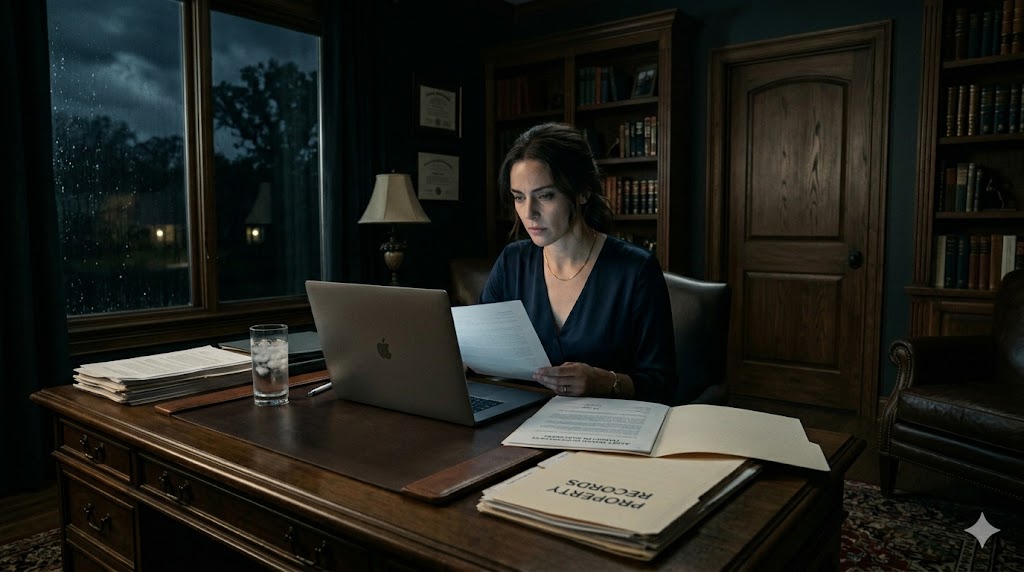
I opened my laptop without turning on the main office lamp. Only the small green light of the screen illuminated the piles of files, the pens lined up in their leather pots, and the framed photo of my mother by the window.
In this photo, she was smiling in front of the veranda, her hands covered with soil after planting her first rose bushes. She wore an old blue sweater, her hair hastily tied back, and in her eyes there was that luminous fatigue of women who have worked too much but never let the world steal their pride.
I looked at it for a long time.
Then I whispered:
“You were right.”
This was no ordinary marital crisis. He wasn’t just a weak husband facing an overbearing mother. It was a hostile takeover attempt, disguised as family duty. And if there was one thing my profession had taught me, it was this: when a structure starts to crack, you should never look only at the fissure. You have to look for the explosive charge hidden behind the wall.
I started with what I knew best: numbers.
Nathan had always been careless with details, especially when he believed that no one was looking at them closely. He left bank statements in kitchen drawers, crumpled receipts in his jacket pockets, open envelopes on the entryway console. For him, money was an impression. For me, money was a language.
And this language rarely lied.
I logged into our joint account and then the one used for household expenses. In less than twenty minutes, I saw enough strange movements to feel my stomach tighten. Regular transfers to a company whose name I didn’t recognize. Recurring payments to a Stamford law firm. Several credit card cash advances. And, above all, three large withdrawals made from a line of credit that I had never authorized him to open.
My name didn’t appear on that line of credit.
But the address of the house appeared everywhere.
I sat perfectly still in front of the screen, my hands flat on the desk. The heating shut off with a gentle sigh, and somewhere in the house, a pipe creaked. Nathan was probably already sleeping upstairs, convinced that he had just planted a reasonable seed in his wife’s mind.
He didn’t know that I had just found the first rotten root.
I printed the statements. Then I opened a blank folder, wrote at the top: MILLER — THREAT TO PERSONAL ASSETS, and started filing each document exactly as I would have done for a client.
By two o’clock in the morning, I wasn’t just suspicious. I had a map.
The company receiving the transfers was owned by Harrison Miller, at least indirectly, through a discreet family entity. The law firm had drafted a contract two months earlier entitled “private residential acquisition proposal.” And Nathan’s credit card advances were not related to his business. They were used to cover personal losses and several debts to private investors.
I leaned back in my chair.
My husband didn’t just want me to quit my job to help his sister.
He needed me to become vulnerable before his debts swallowed him whole.
The next morning, Nathan came down to the kitchen as if nothing had changed. He was wearing a perfectly ironed white shirt, his hair still damp from the shower, and he hummed softly as he checked his phone. On the counter sat two cups of coffee, a plate with half-eaten toast, and the small pile of mail that I had purposely left clearly visible.
I was cooking eggs in a cast-iron skillet, barefoot on the cold tiled floor, dressed in black pants and a gray sweater. An ordinary scene for a couple. It was important for him to believe in it.
“Did you sleep?” he asked.
“A little.”
He kissed me on the temple. I resisted the urge to pull away.
“You’ll see,” he said, grabbing his cup. “With a little perspective, Mom’s idea will seem less brutal.”
I flipped the eggs slowly.
“Maybe.”
He stopped.
That single word gave him hope. I saw it in his shoulders, in the slight loosening of his mouth, in the way he suddenly seemed lighter.
“Really?”
“I’m just saying that I have to look at it calmly.”
He smiled.
“That’s all I ask of you.”
No, I thought. What you’re asking me to do is let my guard down long enough for your family to get their hands on the one thing my mother left me.
But I only slid the eggs onto his plate.
“Eat before it gets cold.”
At nine o’clock, I was in my office, door closed, headphones on. At five minutes past nine, I called my lawyer, Dana Whitmore.
Dana wasn’t just an attorney. She was a fifty-year-old woman with a calm voice, thin-rimmed glasses, and the instincts of a well-trained watchdog. She had managed the transfer of ownership from my mother. She knew the house. She knew the story.
After listening to my summary of the dinner, the statements, the transfers, and the purchase proposal, she remained silent for a few seconds.
Then she said:
“Amelia, do not sign anything. Not a draft. Not a permit. Not even a document presented to you as purely administrative.”
“I suspected as much.”
“It’s not enough. I want you to immediately change all your passwords, block Nathan’s access to any account that isn’t strictly joint, and forward the documents to me this morning. I’ll check if he tried to use your address or marital status to secure credit.”
I closed my eyes.
“Do you think he did?”
Her answer was simple.
“I think desperate people rarely use imagination. They repeat the same lies until someone finally looks closely at the paperwork.”
By noon, Dana had already found more than I ever wanted to know.
Nathan had used inflated estimates of our assets in several financing files related to his business. He hadn’t mortgaged my house, because he couldn’t do so without my consent, but he had hinted to lenders that a family down payment was imminent. He had built his promises around a house he did not own.
In other words, my resignation and the sale at a reduced price were not a recent family brainstorming session.
It was the missing piece of a house of cards that was already collapsing.
I spent the rest of the day working as if nothing had happened. Meetings with clients, debt analyses, calls with panicked CFOs. There was an almost cruel irony in saving companies from bad decisions while my own marriage turned out to be a rigged balance sheet.
Around 5:00 p.m., my phone vibrated.
A message from Caroline.
Amelia, I hope you’ve had time to think. Evelyn needs an answer quickly to organize her trip. We will have dinner together on Sunday to finalize.
Finalize.
I reread the word several times. Then I replied:
Of course. Sunday suits me. I will bring a few elements to make everything clear.
The answer came less than a minute later.
Perfect.
I could almost see her smile.
On Sunday, I chose my outfit carefully. Not a soft dress. Not something that asked to be thought of as pretty or accommodating. I put on a midnight blue pantsuit, a cream shirt, black pumps, and my mother’s discreet gold watch. In my bag were three copies of a bound file, a USB drive, and a document prepared by Dana.
Nathan looked at me from the bedroom doorway.
“You look very professional for a family dinner.”
I fastened my bracelet.
“It’s an important discussion.”
He smiled, relieved once again to hear exactly what he wanted to hear.
In the car, he talked non-stop. He talked about the downtown condo, the restaurants within walking distance, the freedom of no longer running a large house, the pleasure I would have spending more time with Leo. I watched the road roll by behind the glass—the bare trees, the street lamps, the lighted windows of Greenwich’s expensive boutiques.
At one point, he placed his hand on my knee.
“You’re doing the right thing, Amelia. You’ll see. Mom will be very grateful.”
I gently brushed his hand away.
“I never make an important choice just to earn your mother’s approval.”
He laughed, assuming I was joking.
I wasn’t joking.
When we arrived at the Miller Estate, the house shone like a showcase. All the windows on the ground floor were illuminated. Lanterns lined the driveway. Inside, the air smelled once more of beeswax, polished wood, and that distinct scent of old money that wafts through homes where no one ever speaks of the hard work it takes to own things.
Caroline greeted me with a smile that was entirely too sweet.
“Amelia, my dear. You look rested.”
“I thought things over a great deal.”
“Excellent.”
Evelyn was already in the living room, a glass of champagne in her hand. The baby wasn’t there. Again. Harrison stood by the fireplace, his fingers wrapped around a glass of bourbon, and Nathan immediately positioned himself between me and his family like a man trying to control the temperature of a room ready to catch fire.
The dinner began with an almost comical politeness. Squash velouté, salmon, roasted vegetables, overpriced white wine. One might have thought we were a civilized family. A family that wasn’t preparing a trap around an embroidered tablecloth.
After the main course, Caroline placed her napkin on her lap and adopted her committee-chair tone.
“Good. I think it’s time to talk about the logistics. Evelyn has to confirm Milan tomorrow. Amelia, have you made up your mind?”
All eyes turned to me.
I put down my fork.
Once again, that sharp little click against the porcelain.
This time, Nathan heard it differently. I saw him turn slightly pale.
“Yes,” I said. “I have made my decision.”
Evelyn smiled before I could even continue.
“Thank God. I really couldn’t postpone this trip any longer.”
I looked at her.
“You won’t have to postpone it on my account.”
Caroline nodded with satisfaction.
“Perfect. So you’ll hand in your resignation tomorrow?”
“No.”
The word dropped into the middle of the table with absolute clarity.
Evelyn blinked.
Caroline didn’t move right away.
Nathan straightened up.
“Amelia—” he began.
I raised my hand slightly, without even looking at him.
“I’m not finished.”
The silence that followed was heavy, but I didn’t savor it. I wasn’t there to enjoy the moment. I was there to close the deal.
I took the first folder out of my bag and placed it in front of me.
“I have decided that I will not quit my job. I will not become Evelyn’s unpaid nanny. I will not sell my mother’s house. Not to you, not to a family company, not to anyone who thinks an inheritance can be extracted by weakening the woman who owns it.”
Caroline chuckled dryly.
“Amelia, no one is weakening you. You are dramatizing a simple family conversation.”
“Really?”
I opened the file.
“Then let’s talk about family. And let’s talk about numbers.”
Harrison finally looked up from his glass.
Nathan whispered:
“Don’t do this here.”
I turned to him.
“You started it here. I am ending it here.”
His face changed. For the first time in years, he no longer looked like the self-confident man everyone admired at dinner parties. He looked like a boy caught with his hands in a forbidden drawer.
I slid a copy of the first document to Caroline.
“Here are the transfers made from our joint account to an entity controlled by Harrison.”
Then a copy to Harrison.
“Here are the draft contracts prepared by your law firm for the acquisition of my property.”
Then a copy to Nathan.
“And here are the financial disclosures in which Nathan implies to lenders that a family down payment will soon resolve his liquidity crisis.”
No one spoke.
Evelyn’s face had lost all trace of boredom.
Caroline stared at the papers as if the text might vanish if she despised it fiercely enough.
“Where did you get this?”
“In my own home. From my own accounts. And with the help of my lawyer.”
Harrison slowly set down his glass.
“You don’t understand the financial nuances of this type of situation.”
I almost laughed.
But this time, there was no amusement in it.
“Harrison, I am a corporate restructuring consultant. I am hired by boards of directors and creditors when companies far more complex than anything your family owns collapse under the weight of debt and lies. I understand financial nuances perfectly. That’s exactly why Nathan lied to you about me for four years.”
The silence became so heavy that even Evelyn stopped breathing audibly.
Caroline slowly turned her head toward her son.
“Nathan?”
He wouldn’t look at her.
I continued.
“My job isn’t just to fill in spreadsheets. My job is to identify hidden liabilities, failing managers, threatened assets, and people who try to disguise a liquidation as a family strategy.”
Harrison clenched his jaw.
“Be very careful with your accusations.”
“I am being exceptionally careful,” I replied. “That’s why I’m holding back on certain legal terms for now. But my lawyer will use them without hesitation if anyone attempts to approach my property ever again.”
Caroline stiffened.
“You are ungrateful. We were trying to help you.”
“No. You were trying to help Nathan fill a financial black hole by using my mother’s house. You were trying to help Evelyn evade the responsibilities she chose. And you were trying to teach me that a married woman in your family automatically becomes an available resource.”
Evelyn slammed her drink down with a sudden gesture.
“You don’t know anything about what I’m going through!”
I turned to her, speaking more gently than I would have thought myself capable of.
“Perhaps. But I do know this: if you need help, you can hire a nanny. You can consult a doctor. You can ask your husband, your parents, or a professional. What you cannot do is sit under a crystal chandelier drinking champagne and decide that my life gets to be your backup plan.”
She flushed red.
“You think you’re so superior.”
“No,” I said. “I think I own my own time. There’s a difference.”
Nathan finally spoke, his voice dropping low.
“Amelia, stop. You’re going to destroy my relationship with my family.”
I looked at him for a long, quiet moment.
For a split second, I saw the man I had married. The one who brought me ginger soup when I was sick. The one who danced with me barefoot in the kitchen when we returned from our honeymoon. The one who wept at my mother’s funeral while tightly holding my hand.
Then I looked at the man sitting across from me now.
The one who had helped his family lay siege to my inheritance.
“Nathan,” I said softly, “you destroyed our marriage the moment you decided that my security was worth less than your public image.”
His face went entirely blank.
Caroline placed her hand firmly on the table.
“You cannot speak to my son like that.”
I closed the file.
“I can. And I am going to be entirely clear. As of this evening, Nathan will not be returning to my house. His personal belongings will be packed and delivered within forty-eight hours by a professional moving service. Our joint accounts will be frozen tomorrow on the advice of my counsel. Any attempt at harassment, abusive contact, or forced access to my property will be legally documented.”
Nathan stood up so abruptly that his chair scraped harshly against the floor.
“Are you throwing me out?”
“No,” I said. “You threw yourself out the moment you tried to sell my mother’s house without even having the courage to call it a betrayal.”
He opened his mouth, but no arguments came out. Because there were none left. Not a single one that didn’t sound ugly when exposed to the light.
Harrison stood up in turn.
“You are making a very costly mistake.”
I stood up as well.
“No. I am correcting a costly mistake. Mine. The mistake of letting you underestimate me long enough to believe that I was an open door.”
I picked up my bag.
Caroline’s face was deathly pale, but her eyes burned with malice.
“You’ll end up alone, Amelia. Women who choose money over family always end up alone.”
That sentence might have cut me deep in the past. Perhaps even two years ago, I would have driven home crying, wondering if I was cold, selfish, too ambitious, or lacking sweetness. But tonight, all I could think about was my mother on the veranda, her fragile hands wrapped around her teacup, her thin but fierce voice.
I turned back to Caroline.
“No. Women who mistake family for submission end up surrounded by predators who use them. I am finally choosing peace.”
I walked out before anyone could formulate a response.
The air outside was cold, crisp, and remarkably clean. I walked down the driveway beneath the lanterns, my heels clicking sharply against the stone. Behind me, the grand Miller estate still glowed—beautiful, imposing, and completely hollow, like all things that appear solid until the moment you discover they rest on an empty void.
Nathan caught up with me near the car.
“Amelia, wait.”
I stopped, but I didn’t unlock the door.
He looked utterly defeated. His tie was askew. His hair, usually styled to perfection, fell loosely across his forehead.
“I’m sorry,” he said.
It was the first time he had uttered those words all evening. Perhaps the first time he had said them without an undercurrent of anger in years.
I looked at him.
“What are you sorry for?”
He blinked.
“Everything.”
“That’s not an answer.”
He swallowed hard.
“I’m sorry I didn’t defend you. I’m sorry I let my parents think they could buy the house. I’m sorry about the debts. I wanted to fix all of it before you found out.”
“By forcing me to quit my career?”
He lowered his gaze.
“I thought that if we sold…”
“If I sold,” I corrected tightly.
He said nothing.
“This house was never ours, Nathan. It belonged to my mother. Then it became mine. You lived there because I trusted you. Those are not the same thing.”
He ran a weary hand over his face.
“I didn’t know what else to do.”
“Then you should have told me the truth.”
“I was ashamed.”
I nodded slowly.
“Shame does not excuse a betrayal. It only explains why you chose to hide it.”
His eyes filled with tears, and for a fleeting second, a tiny fraction of a moment, I felt my heart pull back toward the years when I loved him unconditionally. But love is not a contract that requires a woman to allow herself to be robbed just to prove her loyalty.
I opened the car door.
“Where am I supposed to go?” he asked, sounding almost like a child.
I looked at him over the roof of the vehicle.
“To your family’s house. That’s what family is for, isn’t it?”
Then I got in and drove away.
That night, I came home to an empty house. I locked the front door behind me, placed my keys in the small blue ceramic dish my mother had bought at a summer market, and stood in the hallway for a long time. Everything was silent. Not empty—just quiet.
There was a profound difference.
The following week was brutal, but it brought absolute clarity.
Dana initiated the preliminary legal proceedings. The bank accounts were severed. Digital access codes were changed. A moving company arrived to collect Nathan’s clothes, suits, golf clubs, bottles of scotch, and even that overpriced espresso machine he had bought with my credit card while claiming “we both wanted it.”
I didn’t shed a tear as I watched the boxes leave.
I cried two days later, finding a single pair of his socks forgotten behind the dryer.
Grief is a strange thing. It doesn’t always choose the monumental moments. Sometimes it ambushes you in the laundry room, with a damp towel in your hands and the scent of clean fabric softener around you. I clutched that ridiculous pair of socks to my chest and wept for the woman I used to be—the one who believed that simply being understanding was enough to be loved in return.
Then I threw the socks in the trash.
A month later, Nathan sent me a lengthy text message. It wasn’t a romantic plea or a grand declaration. It was a convoluted explanation filled with regret, where he finally admitted to hiding his debts and allowing his parents to believe he could manipulate me into selling. He mentioned he was starting therapy, trying to restructure his business, and hoped that one day I might find it in myself to forgive him.
I replied with a single sentence:
I hope you finally become a man who can tell the truth before everything collapses around him.
After that, I never responded again.
Evelyn never went to Milan. I learned through a mutual acquaintance that Caroline had ultimately hired a full-time nanny, funded entirely out of her own pocket, which had apparently rendered Evelyn’s experience of motherhood far more bearable. Harrison, meanwhile, vanished from certain high-profile business luncheons for a few months. Financial rumors travel fast in Greenwich, especially when they involve people who have spent their entire lives pretending they are untouchable.
I didn’t add any fuel to the fire.
I didn’t need to.
The truth possessed a certain elegance: once placed plainly on the table, it kept working all on its own.
Six months later, my divorce was well underway. The house remained solely in my name. My mother’s rose bushes had successfully survived the harsh winter. On the very first morning of spring, I stepped outside with a cup of coffee, an old cardigan draped over my shoulders, and discovered tiny new green leaves sprouting from branches I had assumed were entirely dead.
I knelt down in the damp grass.
For the first time in a very long time, I breathed deeply without feeling an invisible hand tightening around my throat.
I hadn’t reclaimed my life overnight. It wasn’t that simple. There were still lawyers to deal with, mountains of paperwork, and nights when I woke up at three in the morning replaying certain sentences in my head. There was still that dull, lingering humiliation of having loved someone who had underestimated me so profoundly.
But there was also something else.
The morning peace of a home that no longer harbored lies.
The steady hum of my own coffee maker.
My open files spread across my desk.
My shoes neatly lined up by the door.
The crisp light flooding the veranda.
And, hanging on the wall of my office, the photograph of my mother.
One Saturday, I bought a new rose bush for the garden. The nursery attendant asked me if I wanted a variety that was easy to maintain or something more resilient.
I looked at the plants lined up before me, their stems still bare, their roots wrapped tightly in damp burlap.
“Resilient,” I told her. “Something that can survive the harshest winters.”
She smiled and handed one over to me.
I planted it right near the porch, precisely where my mother used to sit with her tea. The soil felt cold against my fingers. My knees were caked in mud. My phone was vibrating somewhere inside the house—likely a work email, perhaps an unimportant message. I let it ring.
When I finished, I stood there for a while, my hands dirty, my back aching, and my heart strangely calm.
I thought back to that dinner, to Caroline ordering me to resign as though my future belonged to her. I thought of Nathan claiming that this was simply what families did for one another. I thought of that fork clicking against the china—that tiny, sharp sound that had seemed so insignificant at the time.
Sometimes, a life doesn’t unravel with a dramatic scream.
Sometimes, it pivots entirely on a woman who simply sets down her fork, raises her head, and finally remembers exactly what she is worth.
I didn’t quit my job.
I didn’t raise Evelyn’s child.
I didn’t sell my mother’s house.
And every single morning, when the sun breaks through the veranda and spills across the hardwood floor she chose with her own hands, I realize that her final gift to me wasn’t just this house.
It was the absolute certainty that a sanctuary is never granted to those who confuse love with ownership.
This house is still standing.
And so am I.