After five years of washing my paralyzed husband, I heard him laughing and calling me his “free nurse.” That day, I didn’t scream… that day, I started taking everything away from him without him even knowing.
For five years, I bathed my paralyzed husband. Then, I heard him laugh and call me his “free nurse.” I didn’t scream that day. Instead, I started taking everything away from him, and he had no idea.
—”As long as she serves me.”
Steven froze. The phone was still pressed against his ear. On the other end, Thomas was asking: —”Dad? What happened?”
I walked to the table, set my purse down, and looked at my husband. At this man I had bathed for five years. At this man who had watched me stop buying clothes, stop going out, stop sleeping, stop existing.
—”Hang up,” I told him. Steven tried to smile. —”Brenda, you’re misunderstanding.” —”Hang up.” I didn’t raise my voice. That was what scared him.
Thomas kept talking. —”Dad, is the lady there?” Steven ended the call. —”I don’t know what you heard, but—” —”I heard enough.”
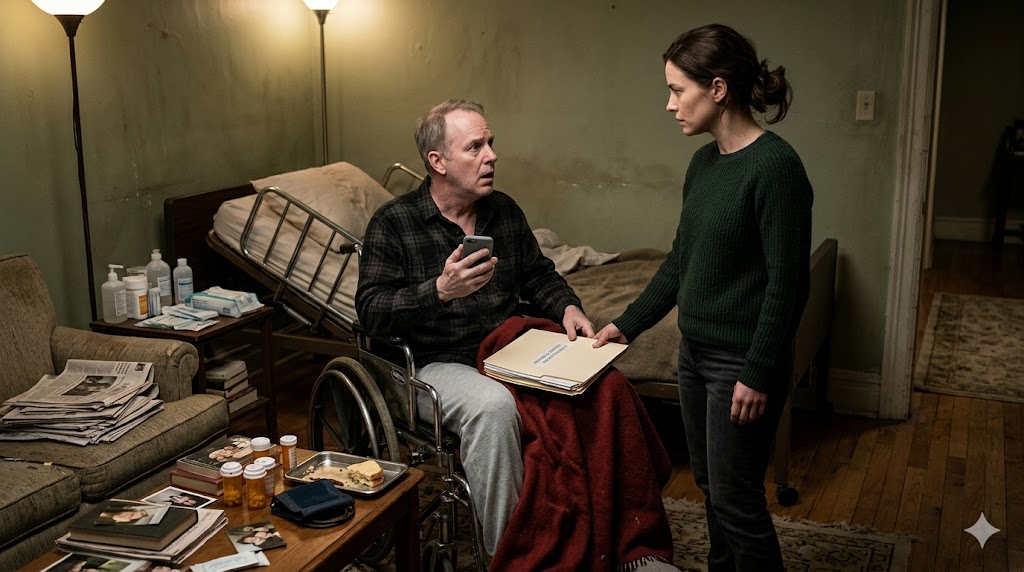
I approached him slowly. His wheelchair was next to the window. The living room smelled of clean diapers, disinfectant, and vegetable soup. The TV was on mute, showing a game show where everyone was clapping as if life were fair.
—”Brenda, don’t start with the drama.” I laughed. A small laugh. Dead. —”Five years wiping your body clean, and you still think my pain is drama.”
His face changed. —”You decided to stay.” —”Yes. And today I decide to stop serving.”
The color drained from his face. —”What does that mean?” I pulled a folder out of my bag. He recognized it immediately. The gray folder. The one he kept in the bottom drawer of the closet, behind some old blankets.
—”Where did you find that?” —”In my house.” —”That’s my private documentation.” —”No. It’s proof that while I was fighting with the insurance company for your physical therapy, you were sending money to Thomas, hiding accounts, and planning to kick me out of the house I’ve maintained for five years.”
Steven gripped the wheels of his chair. —”You can’t do this to me. I’m your husband. I’m sick.” —”Your tongue isn’t sick.”
I placed a sheet of paper in front of him. —”I didn’t sign this power of attorney.” He stared at the paper. He didn’t blink. That’s when I understood that he didn’t just know about it. He had ordered it.
—”It was to protect you,” he said. —”Forging my signature was to protect me?” —”You didn’t understand legal matters.” —”No. You prayed I would never understand.”
The front door opened without a knock. Thomas walked in as always, wearing a baseball cap, expensive sneakers, and an entitled look on his face. —”What are you doing to my dad?”
I didn’t even turn around. —”Good afternoon, Thomas. In this house, you knock.” —”This is my dad’s house.” Now I did look at him. —”No.”
He laughed. —”Oh, lady, don’t start.” I opened another page. —”This house was bought during our marriage, but the down payment came from my account, and I paid for the renovations. Furthermore, your dad mortgaged it without telling me using a forged power of attorney. My lawyer is already reviewing that.”
Thomas stopped smiling. —”Lawyer?” Steven hit the armrest. —”Brenda, you’re exaggerating.” —”No. I’m documenting.”
I took out my phone. I played the audio. Thomas’s voice filled the living room: “When my dad dies, you’re going to get the hell out of this house.” Then Steven’s voice: “Leave her be. As long as she serves me, let her stay.”
Thomas turned red. Steven closed his eyes. —”Turn that off.” —”No.” —”Brenda.” —”My attorney heard it. A psychologist at the Women’s Advocacy Center heard it too. They explained to me that they provide comprehensive legal and psychological support to women based on their needs, with a human rights perspective. I didn’t go there to cry. I went to learn what this is called.”
Steven took a deep breath. —”Did you report me?” —”Not for everything yet.” Thomas stepped forward. —”You crazy bitch, if you think you’re going to take anything from my dad—” —”One more step,” I cut him off, “and I’m calling the police.”
He stopped. Not because he respected me. Because for the first time, he didn’t know how far I had gone. —”Thomas,” I said, “your deposits are over.” —”You can’t do that.” —”They aren’t mine. They were from your dad’s pension and disability checks. But the lawyer is going to request an audit because while he claimed he didn’t have money to pay a nurse, he sure had enough for your trips to Miami, your motorcycle, and your nine-hundred-dollar sneakers.”
Thomas looked at his father. —”You said everything was taken care of.” Steven glared at him. —”Shut up.” I smiled. —”Exactly. Shut up among yourselves. I’m already tired of both of you.”
I went to the door and opened it. Outside stood a woman in a white uniform holding a medical bag. Steven frowned. —”Who is she?” —”Claudia. Registered nurse. Night shift.”
The woman walked in calmly. —”Good afternoon.” Steven looked at me as if I had betrayed him. —”I don’t need a nurse.” —”You said you did. You said it cost a fortune.”
Thomas let out a nervous laugh. —”And who’s going to pay for her?” I dropped the contract on the table. —”Your dad. With his hidden account.”
Steven went pale. —”You don’t have access to that account.” —”No. But my lawyer can petition the court to cover your care with your own assets. And while that gets sorted out, I am no longer working twenty-four-hour shifts for free.”
Claudia checked the hospital bed, the catheter, the medications, and the notebook where I logged the schedules. —”Mrs. Brenda, were you handling this all on your own?” I nodded. —”For five years.” She looked at me with a mix of respect and sadness. —”That is not sustainable.”
I almost cried. Not for Steven. For me. Because all it took was for a stranger to say one simple sentence to confirm what I had been denying to myself for years. It wasn’t sustainable. It wasn’t love. It was exhaustion disguised as virtue. Medicare even has documents outlining how caregivers assist with basic activities like eating, bathing, dressing, transferring, and going to the bathroom, and I had done all of that without a break, without pay, and without a single ounce of gratitude.
Steven looked at me with hatred. —”Are you going to leave me with a stranger?” —”No. I’m going to leave you with a professional.” —”You are my wife.” —”And you called me a free maid.”
Thomas raised his voice. —”My dad is in a wheelchair. You can’t abandon him!” I walked up to him. —”Abandonment is leaving a woman alone with catheters, adult diapers, debts, screaming, and a hospital bed in the living room while the two of you divide up the inheritance. This is called respite care.”
He didn’t know what to answer. Because the pretty words had always belonged to them. Family. Loyalty. Sacrifice. Now I was learning new ones. Rights. Boundaries. Lawsuit.
Claudia began checking his vital signs. Steven shoved her away with a sudden movement. —”Don’t touch me.” She didn’t get upset. —”Mr. Steven, I can wait. But your wife will no longer be providing your nighttime care.” —”I give the orders in this house.”
I looked around. The living room where I slept on a recliner just to hear him breathe. The kitchen where I ate standing up because he would call me before I could even sit down. The modified bathroom I cleaned every single day. The walls covered with photos of our wedding, where I wore a white dress and a face that still didn’t know what awaited her. —”No, Steven,” I said. —”Not here anymore.”
That night I slept in my bedroom with the door closed for the first time. I didn’t sleep well. The body doesn’t learn freedom in a single night. I woke up several times expecting his voice. “Brenda.” “Brenda, water.” “Brenda, turn me over.” “Brenda, don’t be useless.”
But Claudia was in the living room. And every time the urge to get up pulled at me, I squeezed my pillow and repeated to myself: I am not cruel. I am alive.
The next morning, Steven didn’t speak to me. Even better. I made coffee, warmed up a vanilla scone that I had actually bought for myself, and sat at the table. The first bite tasted like guilt. The second, like victory.
At ten o’clock, my lawyer, Attorney Rebecca Vance, arrived. She walked in wearing low heels, carrying a black folder, and with a look that didn’t ask for permission. —”Good morning.” Steven feigned dignity. —”I’m not speaking without my lawyer.” —”Perfect,” she said. —”Then I’m only here to serve notice.”
Thomas arrived as well. Of course. Vultures always recognize the scent of loss. Rebecca pulled out her documents.
—”First. We will request the annulment of the power of attorney falsely signed in Mrs. Brenda’s name. Second. We will demand a full accounting of the insurance funds, disability pension, and hidden accounts supposedly earmarked for medical care. Third. We will initiate proceedings for economic, psychological, and financial abuse.”
Steven scoffed. —”Abuse? I haven’t hit her.” Rebecca didn’t even blink. —”Not all abuse leaves bruises.”
Thomas crossed his arms. —”My dad needs help. If she leaves, who takes care of him?” —”Mr. Steven has assets,” Rebecca replied. —”And a very concerned adult son.”
Thomas opened his mouth. He closed it. I almost clapped. —”I can’t take care of him,” he said. —”I work.” —”I worked too,” I said. —”Except no one called it work.”
Steven looked at me with contempt. —”What do you want, Brenda? Money?” The question made me laugh. —”How funny. After five years wiping up your spit, you think I’m the greedy one.”
I walked up to the bed. —”I want my life back. My share. My name cleared. And I want you to never say that you support me again, when I was the one holding this house together while you were handing out cash like a mafia boss.”
He clenched his jaw. —”Without me, you’re a nobody.” Before, that phrase would have broken me. That day, it only gave me clarity. —”Without you, I’m going to find out.”
The days that followed were a slow war. Steven alternated between playing the victim and the executioner. One day he cried. —”Brenda, I was frustrated. I said stupid things.” Another day he threatened me. —”I’m not leaving you a dime.” Another day he used his chair like a throne. —”Let’s see who’s going to want you after you spent five years taking care of a paraplegic.”
I didn’t answer him on my own anymore. Everything went through Rebecca. Everything was put in writing. Everything was dated. That was my first true revenge: stripping him of the kingdom of the spoken word.
Thomas began to grow desperate when the deposits stopped. He arrived one afternoon screaming that he had pending payments. —”My dad promised to help me.” I was folding laundry. —”Your dad also promised to love me.” —”It’s not my fault you’re bitter.” —”No. Your fault is enjoying the money while treating me like the hired help.”
He stood in the doorway, looking younger than he did when he was mocking me. —”My mom used to say that you took my place.” That stopped me. For the first time, I saw the little boy behind the rude man. But I didn’t make the mistake of carrying his burden. —”Then go to therapy, Thomas. Not to my wallet.” He left, slamming the door.
Two weeks later, Steven got a urinary tract infection. Before, I would have rushed. I would have slept sitting up. I would have cried out of fear. This time, I called Claudia, the doctor, and the ambulance. I went to the hospital. Yes. Not because he deserved it. Because I didn’t want to become what he said I was.
In the ER, a nurse asked me for his information. I provided it. Steven looked at me from the stretcher. —”I knew you would come.” I looked at him. —”I came to hand over your medical records. Not to come back.”
His face crumpled. —”Brenda…” —”I’m going to make sure you receive care. I am not going to be your bed, your purse, your nurse, or your phantom heiress.”
The doctor recommended admitting him for a few days. Thomas didn’t show up. Not once. Steven asked for him. I didn’t answer. Sometimes life makes better confessions than words ever could.
When he was discharged from the hospital, he didn’t return to the house. Rebecca had secured a court order and a temporary agreement: Steven would be transferred to an assisted living facility paid for by his own assets while the legal process moved forward. It wasn’t a punishment. It was bringing order.
When they told him, he screamed. He cried. He called me a traitor. He called me a gold digger. He called me trash. Then, when he saw that nothing was working, he lowered his voice. —”Are you really going to leave me alone?”
I was standing next to the private medical transport. The afternoon smelled like rain and fresh bread from the bakery on the corner. The city kept moving. A lady was buying groceries. A boy pulled at his mom’s arm, begging for a donut. Life had a strange cruelty: it kept going even as a woman buried her marriage.
—”You aren’t alone,” I said. —”You’re cared for. The difference is that you are no longer obeyed.” He wept. This time it actually looked like fear. —”I needed you.” —”No. You used me.” —”I don’t know how to be anything else.”
I felt an old ache. Because maybe that was true. But I no longer had to pay for a man’s emotional inability with my back, my hands, and my youth. —”Learn,” I told him.
The medical transport drove away. I stood on the sidewalk, not knowing what to do with my arms. For the first time in five years, no one was going to call me at three in the morning. And instead of feeling freedom, I felt emptiness. An enormous void. Like a house after hauling out a rotten piece of furniture that had been stinking for years.
The house fell silent. Not a pleasant silence at first. A frightened silence. The first day, I cleaned the living room. I got rid of the hospital bed. When the movers took it away, the track marks from the wheels were left on the floor. I mopped it once. Two. Three times. It wouldn’t come out. I sat down and cried.
Not for Steven. For the twenty-nine-year-old Brenda who set up that bed with hope, believing that love could somehow rehabilitate someone’s soul. Then I opened the windows. Air flowed in. Real air. Not the smell of ointment. Not bleach. Not reheated soup. Air.
That week I went downtown. Alone. I sat by the fountain, bought a street hot dog—the kind I used to avoid because Steven hated the smell of onions—and I stained my blouse. I laughed. No one scolded me.
Then I walked into a bakery and bought a vanilla scone. Not for him. For me. I took a bite while walking slowly through the city square, watching couples, street vendors, balloons, and children chasing bubbles. I thought about the highway to Palm Springs, the accident, and the woman I was before and after.
For years, everyone talked to me about Steven’s tragedy. No one ever asked me about mine. Mine didn’t show up on X-rays. Mine didn’t require a wheelchair. But it paralyzed me too.
The legal process lasted for months. The forged power of attorney was annulled. My equity in the house and the assets acquired during the marriage was recognized. The hidden accounts came to light. So did the deposits to Thomas.
Steven had to pay for professional care, medications, and debts he had hidden while I was selling my old clothes just to finish buying groceries. I didn’t take everything. It was never about that. I kept what was mine. Which, after five years of feeling like I was living on borrowed time, felt like an absolute fortune.
Thomas showed up one last time. He arrived without yelling. Without his cap. Without his arrogance. —”My dad told me he can’t help me anymore.” —”I know.” —”He also told me it was your fault.” —”I’m sure he did.”
He stood by the entryway. —”I found the voice memos.” I looked at him. —”Which ones?” —”The ones he sent to his friends. Talking about you. About me. About everyone.” His face was pale. —”He used me, too.”
I didn’t say “I told you so.” It wouldn’t have helped him. —”I’m sorry.” Thomas lowered his gaze. —”I was an idiot to you.” —”Yes.” —”I’m sorry.”
The word arrived late, but it arrived. —”I don’t know what to do with that apology,” I answered. —”But I wish you no harm.” He nodded. —”Can I take some clothes to his facility?” —”Yes. Coordinate it with the administration there. Not with me.” He understood. That was the closest thing we got to peace.
A year later, my living room no longer looked like a hospital ward. I bought a yellow armchair. I bought plants. I hung light curtains. I started wearing perfume again. I went back to wearing form-fitting dresses, not to please anyone, but to remind myself that my body wasn’t just a caregiving tool.
I also enrolled in a nursing assistant course. On the first day of class, I cried in the bathroom. I thought I would hate everything related to caregiving. But no. What I hated was caregiving without respect. Caregiving without rest. Caregiving for someone who mocked my hands while depending entirely on them.
The instructor spoke about caregiver burnout, and I felt like she was reading my story out loud. I didn’t raise my hand. Not yet. But I wrote in my notebook: “I was not a free nurse. I was an exploited woman who learned too late how to charge for her services in freedom.”
Some time later, I received a letter from Steven. He sent it from the care facility. I didn’t open it as soon as it arrived. I left it on the table for three days. When I finally read it, it said:
“Brenda: Everyone here charges to take care of me. No one guesses what I need. No one runs if I yell. No one hates me, but no one obeys me out of love. I think that was what I confused with you. I don’t know how to ask for forgiveness without wanting something in return. I am learning. Steven.”
I folded it. I didn’t cry. I kept it in a box, not out of affection, but as proof that even comfortable monsters are forced to look in the mirror when their free room service is cut off.
I didn’t go back to him. I didn’t have to in order for my story to have compassion. Compassion can also exist behind a locked door.
One Sunday, I went to the local bakery for pastries. I bought two scones. A vanilla one. A chocolate one. I sat on a bench outside and set them on my lap. For years I bought his favorites. That day I tried the chocolate one. I liked it better. Much better. I laughed to myself, with sugar on my fingers and the sun on my face.
For five years I thought love meant staying even if it broke me. Later I understood that love was also calling a nurse, hiring a lawyer, opening windows, hauling a hospital bed out of the living room, and saying: “I am not abandoning a sick man. I am abandoning abuse.”
Steven believed he had me for room and board. Thomas believed I was just some lady waiting to be evicted. His friends believed I was a free nurse. And maybe, for a time, I was.
But even a woman treated like a piece of furniture learns how to move when she discovers she still has legs. That day I didn’t scream. I didn’t break plates. I didn’t throw his pastries at him.
I simply started taking away everything he never should have had: My money. My relentless labor. My silence. My fear. My life.
And when I was done, the only thing left in his hands was what had always belonged to him: His body. His son. His choices. and the exact loneliness he built while laughing at the woman who was holding him up.
Part 3:
—”Since ‘as long as she serves me’.”
Steven frozen, the phone still pressed to his ear. On the other end, Thomas’s voice could be heard: —”Dad? Are you there?” I walked over to the table and set my purse down. —”Hang up.” Steven tried to smile, but the smile didn’t quite reach his eyes. —”Brenda, you’re misunderstanding.” —”Hang up, Steven.” I didn’t yell. That was what scared him the most. Because for five years I had begged, explained, cried, and asked for forgiveness for things that weren’t even my fault. That night my voice came out clear. Cold. Like a door closing.
Steven hung up. —”I don’t know what you heard, but Thomas and I were talking about legal matters. You wouldn’t understand.” I smiled. —”You thought so.” I pulled a black folder out of my bag and placed it on the table. His face changed as he recognized it. —”Where did you find that?” —”In your desk. In the drawer you kept locked under your chair.” He swallowed hard. —”That folder is private.” —”Not when it contains my forged signature.”
Silence fell over the living room. The hospital bed was by the window. The wheelchair, half a meter away. The table with medications, adult diapers, gauze, and water bottles. My entire life reduced to a makeshift infirmary where I was the only one without a clock-out time.
Steven tried to sit up a bit. —”I never forged anything.” I opened the folder. —”Power of attorney to move money from our joint account. My signature. But that day I was at Medicare with you, fighting because they didn’t want to authorize your physical therapy. I have the records.” He clenched his jaw. —”It was to protect us.” —”No. It was to protect your plan.”
I flipped to another page. —”Will. Everything to Thomas. The house, the accounts, the insurance, the furniture. You even put ‘in the event that Brenda continues to occupy the property, she must vacate within thirty days’.” Steven lowered his gaze. —”Thomas is my son.” —”And I am the woman who cleaned your body for five years.” —”You did that because you wanted to.”
There it was. The complete sentence. The unvarnished truth. No gratitude. No love. No partnership. You wanted to. As if I had chosen to be invisible. As if love were a contract where one party surrenders their life and the other signs the inheritance over to someone else.
I stepped closer to him and placed my cell phone on the table. —”I also recorded this.” I pressed play. Thomas’s voice filled the room: “When my dad dies, you’re going to get the hell out of this house.” Then Steven’s voice: “Leave her be. As long as she serves me, let her stay.”
Steven closed his eyes. Not out of guilt. Out of annoyance. —”Turn that off.” —”No.” —”Brenda.” —”My lawyer heard it.” His eyes snapped open. —”What lawyer?” —”The one who told me that your problem wasn’t needing a nurse. It was believing you could enslave your wife.”
The door swung open. Thomas walked in without knocking, as usual. —”What are you doing to my dad?” He was twenty-four, with new sneakers, an expensive baseball cap, and that look of a boy raised to believe everything belonged to him. He walked past me as if I were part of the furniture. —”Good evening, Thomas,” I said. “In this house, we now knock before entering.” He laughed. —”This is my dad’s house.” I pulled out another document. —”No.” Thomas frowned. —”What do you mean, no?” —”This house was purchased during the marriage. The down payment came from my account. I paid for the renovations. The hospital bed, the ramp, the modified bathroom, the converted van. Everything is documented.” I looked at Steven. —”And it’s also documented that you used a forged power of attorney to move money without telling me.”
Thomas turned toward his father. —”Forged power of attorney?” Steven exploded. —”Shut up, Thomas!” I almost smiled. For the first time, the spoiled son was hearing the tone I received every single day. —”The monthly deposits are also in here,” I continued. “Fifteen thousand. Twenty thousand. Thirty thousand. While I was selling my old clothes to buy medical gauze, you were paying for Thomas’s motorcycles, trips, and gambling.” Thomas turned red. —”It wasn’t gambling.” —”Right. ‘Sports entertainment’.”
He stepped toward me. —”Don’t talk to me like that.” I took a step toward him. Not much. Just enough. —”One more step and I’m calling the police. And this time it won’t be because ‘the wife is hysterical’. It will be because I have audio recordings, documents, and a lawsuit ready to file.” Thomas froze. Steven looked at me as if he didn’t recognize me. How funny. I didn’t recognize myself either. And I liked it.
At that moment, the doorbell rang. Thomas turned around. —”Who is that?” —”The nurse.” Steven went completely still. —”What nurse?”
I opened the door. Claudia walked in wearing a white uniform, carrying a medical bag, and with a professional expression that asked no permission. —”Good evening. I’m Claudia Mendez. Night shift.” Steven clenched his fists. —”I didn’t request a nurse.” —”I did,” I replied. “With your hidden account.” Thomas raised his voice. —”What do you mean with his account?” —”The one your dad kept hidden while claiming there was no money to hire help.”
Claudia approached to review the medication log. —”Were you managing all this alone?” she asked me. I nodded. —”For five years.” She looked at me seriously. —”That isn’t caregiving. That is extreme exhaustion.” My eyes burned. I didn’t cry. But I almost did. Because sometimes you wait years for someone to name what you’ve been living through every single day.
Steven refused to let Claudia touch him. —”I don’t need strangers.” —”Then ask Thomas to bathe you,” I said. Thomas opened his mouth. He closed it. He looked at his father. Then he looked at his watch. —”I have to work tomorrow.” I laughed. A low, sad laugh. —”I worked too. Except here, nobody called it work.”
That was the first thing I took from Steven: My availability.
The second was my fear. That night I didn’t sleep in the living room. I slept in my bedroom. With the door closed. At first, I couldn’t close my eyes. Every sound made me lift my head. The wheelchair. The voice. A glass clinking. Claudia moving around. My body still believed that if Steven called, I had to run. But I didn’t run.
At three in the morning, I heard his voice: —”Brenda!” I sat up in bed. I gripped the sheet. Claudia answered from the living room: —”I’m right here, Mr. Steven. What do you need?” There was silence. Then he said: —”Nothing.” I smiled in the dark. Not out of happiness. Out of freedom learning how to walk.
The next morning, my lawyer, Attorney Rebecca Vance, arrived. She wasn’t the type to say “oh, you poor thing.” She was the type to put a pen in your hand and say: —”Now sign for yourself.”
Steven was in the living room, dark circles under his eyes. Thomas had returned as well, now sporting the attitude of an official public defender. Rebecca placed documents on the table. —”First: we will request the annulment of the forged power of attorney. Second: an audit of accounts and funds used without Brenda’s consent. Third: asset protection orders. Fourth: legal separation. Fifth: formal contracting of professional care to be paid from Mr. Steven’s personal assets.”
Thomas slammed his hand on the table. —”And what about my dad? Who’s going to take care of him?” Rebecca looked at him. —”You are a legal adult.” Thomas lowered his hand. —”I’m not a nurse.” —”Neither is Brenda.” The sentence left him speechless.
Steven spoke in a deep voice: —”Brenda can’t abandon me. I am disabled.” Rebecca didn’t flinch. —”No one is proposing to abandon you. We are proposing to stop exploiting her.” —”She is my wife.” —”Not your property.”
Steven looked at me. —”Say something to them.” Before, that look would have pierced me. Tell them I’m not a bad guy. Tell them you’re exaggerating. Tell them you still love me. Tell them you’ll take care of me. I stayed quiet. And that silence was the third thing I took from him: My defense.
For weeks, Steven tried everything. First, guilt. —”After everything we’ve been through, this is how you repay me?” Then, pity. —”I can’t even move my legs, Brenda.” Then, insults. —”Nobody is going to want you after you lugged a paraplegic around for five years.” Then, fake tenderness. —”My love, I said stupid things. I was frustrated.”
I listened to him the way someone listens to rain behind a closed window. I wasn’t getting wet anymore.
Everything went through Rebecca. Everything was put in writing. Everything was documented. That made him desperate. Men like Steven love the spoken word because later they can claim they didn’t say it, that they were misunderstood, that you’re exaggerating. But once everything is on paper, abuse starts losing its makeup.
Thomas stopped receiving money by the third day. On the fifth, he showed up furious. —”My card declined.” I was in the kitchen, making coffee for myself. —”What a shame.” —”My dad always helps me.” —”Then ask your dad.” —”He says you froze everything.” —”I froze my money.” Thomas clenched his jaw. —”Because of you, I’m going to lose my motorcycle.” I looked at him. —”I lost five years.” He didn’t answer. Because not even all his arrogance could compare a motorcycle to a life.
Two weeks later, Steven got an infection. Before, I would have panicked. I would have slept sitting next to him. I would have cried in the bathroom so he wouldn’t see me. This time, I called Claudia, the doctor, and the ambulance. I went to the hospital. Yes. But not as an enslaved wife. I went with a folder of his medical history and a medication list. When the nurse asked me if I would be the primary caregiver, I answered: —”No.” The word tasted strange to me. Guilty. But necessary.
Steven looked at me from the stretcher. —”Brenda…” —”Here is your file. Claudia has the instructions. Thomas was notified.” —”He’s not going to come.” —”I know.” The truth fell between us like an old, heavy object. Thomas, his blood, his heir, the son for whom he erased me from everything, did not show up to the hospital even once. Not once. He sent a text: “Let me know if it gets serious.” Steven read it. He didn’t say anything. But that night, when he thought I was asleep in the corner chair, I heard him cry. I didn’t feel triumphant. I felt exhausted. Cruelty is also draining when you stop feeding it.
Upon leaving the hospital, Steven did not return to the house. With the help of Rebecca and the social worker, we arranged for him to be temporarily transferred to an assisted living facility, paid for with his own resources while the legal situation was resolved. When they told him, he became furious. —”You’re throwing me away.” —”No. I’m leaving you in the hands of trained professionals.” —”You promised to take care of me.” —”And you promised to love me.” That silenced him.
The private medical transport arrived on a Tuesday afternoon. The living room was clean. The hospital bed no longer had its sheets. His medications were organized in a box. His clothes in two suitcases. Steven looked at me as they secured him onto the stretcher. —”Are you really not coming with me?” —”No.” —”Not even to get me settled?” —”No.” —”Brenda, I’m scared.”
That sentence did hit me. Because fear, when it comes out sincere, looks far too much like the man you once loved. I stepped closer. —”I was scared for five years, too.” He lowered his gaze. —”I didn’t know.” —”Yes, you did. You just didn’t care as long as I kept going.” The paramedics waited in silence. Steven wept. —”I needed you.” —”No. You used me.”
The transport drove away. I stood at the door of my house, not knowing what to do with the air around me. Because nobody tells you that: When you first break free, you initially don’t know how to breathe.
The house felt enormous. I removed the hospital bed from the living room. The track marks from the wheels were left on the floor. I mopped it once. Twice. Three times. It wouldn’t come out. I sat on the floor and cried. For me. For the twenty-nine-year-old girl who brought that bed in with hope, believing that love could also rehabilitate someone’s soul. Then I opened the windows. Air flowed in. Real air. Not the smell of ointment. Not bleach. Not reheated soup. Air.
That week, I went downtown. Alone. I sat by the fountain, bought a street hot dog—the kind I used to avoid because Steven hated the smell of onions—and I stained my blouse. I laughed. No one scolded me. Then I walked into a bakery and bought a vanilla scone. Not for him. For me. I bit into it while walking slowly through the plaza, watching couples, vendors, balloons, children running after bubbles. I thought about the highway to Palm Springs, about the accident, about the woman I was before and after.
For years, everyone talked to me about Steven’s tragedy. No one ever asked me about mine. Mine didn’t show up on X-rays. Mine didn’t require a wheelchair. But it paralyzed me, too.
The legal process lasted for months. The forged power of attorney was annulled. The hidden accounts were audited. My share of the house and the assets acquired during the marriage was legally recognized. Thomas had to return part of the money he received without justification. Not all of it. Justice is never perfect. But enough so that he stopped walking into my house like he owned it.
One day he came to see me. Without his cap. Without his arrogance. —”Brenda.” —”What do you want?” —”My dad says he can’t pay for the facility if I don’t help.” —”Then help.” He stood there uncomfortably. —”I don’t know how to take care of him.” —”Learn.” —”I can’t handle that.” I looked at him for a long time. —”I couldn’t handle it either. But everyone assumed I could because I’m a woman.”
Thomas lowered his head. —”I was an idiot to you.” —”Yes.” —”I’m sorry.” I didn’t hug him. I didn’t tell him it was okay. Because it wasn’t okay. But I didn’t destroy him either. —”Do something useful with that apology. Not with me. With your dad. With your life.” He left.
Months later, I received a letter from Steven. I left it on the table for three days before opening it. It said: “Brenda: Everything has a schedule here. Nobody runs when I yell. Nobody guesses what I want. If I treat a nurse badly, they write a report. If I need something, I ask for it nicely. I didn’t realize how much of my personality was just permitted cruelty. I think I turned you into a service. I don’t know how to ask for forgiveness without hoping you’ll come back. I am trying to learn. Steven.”
I read the letter twice. Then I put it away. Not because I forgave him. Because it was proof. Proof that even a man sitting in a chair can use love as a whip. And proof that a woman can drop the whip on the floor and walk out.
I didn’t go back to him. I visited him once, months later, accompanied by Rebecca. Steven was in the garden of the care facility. He had a blanket over his legs and a different face. Not good. Not bad. Smaller. —”You look well,” he said. —”I look rested.” He nodded. —”Thomas came yesterday.” —”That’s good.” —”He didn’t stay long.” —”He’ll have to learn, too.” He looked at me. —”Do you hate me?” I thought about answering quickly. But I no longer lived to give him comfortable answers. —”No.” His eyes filled with tears. —”Then?” —”I just don’t belong to you anymore.”
That was all. There was no kiss. There was no promise. There was no reconciliation.
As we were leaving, Rebecca asked me: —”How do you feel?” I looked at my hands. The same ones that bathed him. The same ones that signed the lawsuit. The same ones that now held my purse, my keys, and my life. —”Light,” I said. “And sad. But mine.”
A year later, I finished a nursing assistant course. People were surprised. —”After all that, you want to take care of sick people?” I would answer: —”I didn’t hate caregiving. I hated being used.” I learned the difference. Caregiving with respect dignifies. Caregiving without rest destroys. Caregiving out of love doesn’t mean disappearing.
The day I received my certificate, I went to the local bakery and bought two scones. A chocolate one for me. A vanilla one. I didn’t take the vanilla one to Steven. I left it on a bench for a woman asking for spare change outside the bakery. —”Is this for me?” she asked. —”Yes.” She smiled. I walked away with sugar on my fingers and a strange peace in my chest.
Steven believed I was a free nurse. Thomas believed I was just some lady waiting to be evicted. Steven’s friends believed my love was a chain. They were wrong.
My love was massive. So massive it almost swallowed me whole. But the day I heard his laugh in the rehabilitation courtyard, I understood that not everything you carry deserves to be saved.
So I started taking everything away from him. Not his medication. Not his care. Not his human dignity. I took away what he never should have had: My fear, My money, My silence, My exhausted body, My guilt, My bed, My house, My life.
And when I was finished, Steven wasn’t abandoned. He was cared for. But no longer by the woman he called free. He was left facing himself. With his son. With his choices. With his loneliness.
And I was left facing an open door, a chocolate scone in my hand, and a truth that took me five years to learn: A wife can fulfill a promise of care without accepting a life sentence of servitude. And a woman can love deeply. Very deeply. But she can also get tired. And when a good woman gets tired of being used, she doesn’t need to scream. She just gathers her proof. Signs her name. And quietly takes her life back.