I never trusted my wife and decided to give all my savings to my mother… but the day I went back to my hometown to take my money back, a single sentence shattered my life.
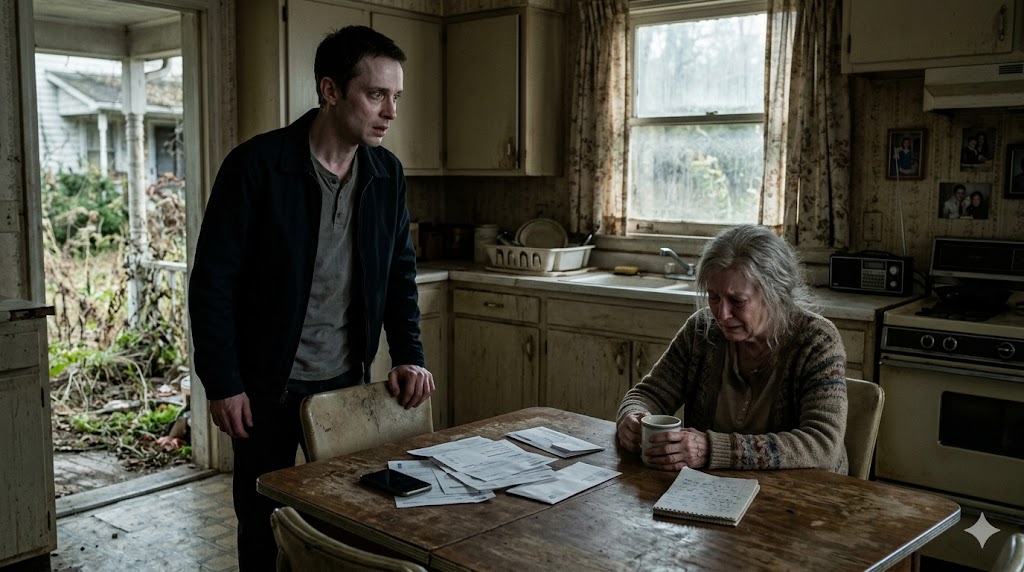
“It doesn’t hurt that you don’t want to open an account with me, Matthew,” Elena told me that night. “It hurts that you look at me as if I were a threat.”
I set my fork down on the plate. “Don’t start.”
“I’m not starting. I’m finally understanding.”
Her voice was calm. That was the worst part. When Elena yelled, I could defend myself. When she spoke calmly, she left me completely exposed.
“I’m just being careful,” I replied.
She looked at me for a long moment. “No. You aren’t being careful with me. You’re being distrustful. And it’s not because of anything I’ve done.”
I felt a surge of anger. Because she was right. And because I didn’t want her to be.
“So now it turns out I’m the bad guy for protecting my money?”
Elena looked down at her notebook. She closed it slowly. “No, Matthew. The sad thing is that you say ‘my money’ even when we’re talking about our life.”
That sentence hung heavily between us. We didn’t argue anymore. But that night, we slept back-to-back. I was wide awake. She was too. I could tell by her breathing.
The next day, I wired another thousand dollars to my mother. Not because I needed to. Out of pride. As if each transfer were a way to prove to myself that I wasn’t an idiot.
My mother replied almost immediately. “Very good, son. It really is safe here. A wife should never know everything.”
I read the text on the subway, packed tight among sweaty commuters, headphone vendors, and a child fast asleep against his mother’s backpack. I felt a false sense of peace. The kind that looks like security, but is actually just well-groomed fear.
Years passed. Elena stopped bringing it up. To me, that felt like a victory. How stupid I was. A woman who stops asking for trust hasn’t always accepted your way of loving. Sometimes, she’s just starting to say goodbye in silence.
We kept sharing a home. Meals. Bills. Sunday mornings at the local market. Family birthdays. But something had gone out. Elena no longer showed me her notebook. She no longer talked about a house. She no longer asked me how much I was saving. And I mistook her silence for peace.
Until one November afternoon, after viewing a condo for sale in Astoria, she turned to me on the sidewalk and said: “I like it.”
It was an older apartment with original hardwood floors, a small kitchen, and a balcony where her plants would fit perfectly. It wasn’t luxurious. But it had light. So much light.
“It’s expensive,” I said.
“Not if we put down a solid down payment.”
I felt a sharp blow to my chest. Three hundred thousand dollars. My secret. My pride. My life jacket.
Elena looked at me. “Do you have any savings, Matthew?”
I stayed quiet for far too long. She understood before I even spoke.
“I do have savings,” I said at last.
Her eyes filled with a cautious hope. “How much?”
I swallowed hard. “Nearly three hundred thousand.”
Elena put her hand over her mouth. She didn’t smile. She didn’t celebrate. “Three hundred thousand dollars?”
I nodded. “I’ve been keeping it put away.”
“Where?”
That was where everything shattered. Because a lie can sustain itself for many years, but it always takes just one simple question to kill it.
“With my mom.”
Elena didn’t blink. “You sent three hundred thousand dollars to your mother?”
“Not all at once.”
“Oh, good. Then it’s totally fine.” Her sarcasm stung.
“It was safe money.”
“Safe from whom? From me?”
I didn’t answer. She took a step back. “Tell me the truth. How many years have you been sending her money?”
“Since before we got married.”
“And throughout our entire marriage?”
“Yes.”
She covered her face with her hands. When she lowered them, she wasn’t crying. That scared me even more.
“I paid bills thinking we were barely scraping by,” she said. “I stopped buying things for myself. I budgeted down to the penny. I sold my car to clear a household debt. You watched me do all of it and you said absolutely nothing.”
“It was for our future, too.”
“No. It was for your fear.”
I wanted to defend myself. I couldn’t find the right words. Only my mother’s words came to mind. And they all sounded filthy in my mouth.
Elena took a deep breath. “Go get your money.”
“What?”
“Go back home to Pennsylvania. Bring it back. If it exists, if it’s completely intact, if it truly was for us, then we’ll talk to the real estate agent.”
“And what if I don’t want to go this week?”
She looked at me with a sadness that wasn’t anger. It was exhaustion. “Then don’t you ever say ‘our future’ again.”
The next day, I took time off from work. I hit the highway toward Pennsylvania with a sick feeling in my stomach. At the toll plaza, while waiting, I thought about Elena. About her notebook. About her plants. About the times I let her pay for a prescription, a repair, or groceries, while my money traveled back to my hometown like a loyal soldier serving my own distrust.
The drive back to Pennsylvania always stirred something up in me. The rolling hills in the distance. The roadside diners. That specific blend of nostalgia and woodsmoke. The local tourism boards always describe historic small towns as places with deep roots and heritage that showcase a community’s identity; my hometown wasn’t famous, but it had that exact same way of guarding secrets behind colorful facades and old church bells.
I arrived shortly after noon. My mother lived on the exact same street as always, but the house was no longer the same. It had a brand-new facade. A modern wrought-iron gate. New tiling. A half-finished second story. Large, beautiful planters. Brand-new aluminum-framed windows.
For a split second, I felt proud. Then came the dread.
My mother stepped out wearing a clean apron and fresh lipstick. “Matthew, honey! You didn’t tell me you were coming.”
I hugged her. She smelled of fabric softener and cooking. Like childhood. Like a trap.
“I need to talk to you, Mom.”
Her smile tightened. “Come inside. I made pot roast.”
I walked in. The living room had brand-new furniture. A massive television. A French-door refrigerator in the kitchen. My younger brother, Andrew, was sitting at the dining table with his wife and their two kids.
“Well, look who it is,” he said. “The engineer came to visit.” He hugged me with a heavy slap on the back.
I looked around. Every single thing looked like it had been bought with my sweat. Every tile. Every light fixture. Every gold-accented decoration that my mother could never have afforded on her pension alone.
We ate in silence. Or rather, they ate. I just moved the food around with my fork. My mother talked about the town fair, a sick neighbor, grocery prices, and traffic on the highway.
I could only think one thing: Three hundred thousand dollars. Three hundred thousand dollars. Three hundred thousand dollars.
When Andrew took the kids out to the backyard, I set my phone down on the table. “Mom, I need to withdraw my money.”
The silence was immediate. My mother stopped pouring the water. “What money?”
I felt a sharp pain at the base of my neck. “The money I’ve been sending you all these years.”
She set the pitcher down very slowly. “Oh, that.”
That. As if she were talking about a tablecloth. Not ten years of my life.
“Yes, Mom. That.”
She sat down across from me. “What do you want it for?”
“Elena and I are going to buy a condo.”
Her expression changed. Not a lot. But I saw it. A shadow passing over her face.
“Does Elena know now?”
“Yes.”
My mother pressed her lips together. “I told you that you shouldn’t tell her.”
“I didn’t come here to argue about that. I need you to transfer the money to me.”
She looked out toward the backyard. Then she looked back at me. “I can’t.”
My heart pounded against my ribs. “What do you mean you can’t?”
“It’s not available.”
“Is it invested?”
She didn’t answer.
“Mom.”
She stood up. “Let’s go to the bedroom.”
I followed her. My legs felt incredibly heavy. We walked into her room. She closed the door. The exact same door where, as a boy, I used to listen to her advice about women, money, and betrayal.
She pulled an accordion folder out of the closet. She laid it on the bed. Inside were receipts. Contracts. Bank statements. Deeds. Loan papers. Invoices for construction materials. A new truck. The second floor. A commercial property down the road. A plot of land. Everything was in my mother’s name. And a portion was in Andrew’s name. Nothing was in my name.
I couldn’t breathe. “What is this?”
“Your money at work.”
“At work for whom?”
My mother lifted her chin. “For the family.”
“I am family.”
“Of course you are, son.”
“Then why isn’t anything in my name?”
“Because you live in the city. You have a job. You have a wife. Andrew stayed here.”
My face flushed hot. “Mom, I sent you that money for you to keep it safe for me.”
She frowned. “We never signed anything.”
That sentence was a knife. Not legally. Maternally.
“What?”
“We never signed anything, Matthew. You sent it to me because you wanted to help.”
“No! You told me, ‘Your money is safe here.’”
“And it was safe. Elena didn’t get her hands on it.”
I just stood there, staring at her. There it was. The complete, twisted logic. It didn’t matter that she had spent it. It didn’t matter that Andrew was living off my savings. It didn’t matter that my marriage had withered away from a lack of trust. To her, the victory was simply that Elena hadn’t touched it.
“You stole from me,” I whispered.
My mother put her hand to her chest. “Don’t you dare talk to me like that.”
“You stole three hundred thousand dollars from me.”
“I gave you life!”
“And I gave you my future.”
Her face hardened. “Don’t be ungrateful.”
That word made me laugh. A hideous laugh. Almost a bark. “Ungrateful?”
“All of this will be yours too, someday.”
“When? When Andrew feels like it? When you die? When Elena leaves me because she finally realizes my mother was my true financial wife?”
My mother slapped my face. Not hard. But enough.
I stayed completely still. I wasn’t a child anymore. And yet, for a split second, I was. The little boy who listened to stories about thieving women while his own mother built the perfect blueprint to rob him blind.
Then she said the sentence that destroyed my life: “Elena was the only one who didn’t want your money, Matthew.”
The room went dead silent. My mother regretted it the second it left her mouth. But it was too late. Because that sentence blew open a door that I had kept locked for years.
Elena had never asked me for luxuries. She had never demanded financial accounts to control me. She had never asked for money for herself. She asked for a joint account. A home. A plan. She asked for trust. And out of fear that she would rob me, I handed everything over to the person who taught me to be afraid in the first place.
I walked out of the room without saying a word. Andrew caught up to me in the yard. “Don’t start acting crazy, Matthew. The house is for Mom, too.”
I looked at him. “Did you know?”
“Mom said you agreed to it.”
“To putting my money in your name?”
He shrugged. “Well, you make good money.”
I wanted to hit him. I didn’t. Maybe because, for the first time, I understood that in this family, I wasn’t a son. I was a bank.
I grabbed the folder and walked out. My mother followed me to the front door. “Where are you going?”
“To see what I can recover.”
“You’re not going to sue your own mother.”
I paused. “No. I’m going to sue the woman who used being my mother to strip me of everything.”
It hurt her. But not enough.
I went down to the town center to find a cell signal. I called Elena. It rang several times before she answered. “Do you have it?”
I couldn’t speak. She understood immediately. “Matthew.”
“It doesn’t exist.”
There was a long silence. “Nothing?”
“She spent it. On the house. On Andrew. On land. On a commercial property. Everything is in her name.”
Elena breathed out slowly. “I’m sorry.”
That completely broke me. She didn’t say, “I told you so.” She didn’t say, “You got what you deserved.” She said, “I’m sorry.”
The woman I had treated like a threat still had a compassion that I did not deserve.
“Elena, forgive me.”
“I can’t do that over the phone.”
“I’m going to fix this.”
“Don’t fix it for me. Fix it because you finally understand who taught you to be so paranoid.”
She hung up.
I stood there in the town square. The pavilions were full of people, street vendors selling elotes, kids running around, and a local band practicing near the church. Everything kept moving forward. But I was completely frozen.
The next day, I went to the Pennsylvania Bureau of Land Records to look into the property histories. They offer public records access, title searches, and appointments to review the legal status of properties and deeds. It wasn’t fast. It wasn’t dramatic. It was worse. It was bureaucratic.
Copies. Fees. Waiting in lines. Stamps. Names. And every single document confirmed the exact same thing: My money already belonged to other people.
Legally, it was a nightmare. Morally, it was crystal clear.
My lawyer back in New York, recommended by a coworker, was brutally honest. “Matthew, do you have a loan agreement? A contract? A promissory note? Any text messages where she explicitly admits she was just holding it for you?”
I showed him the conversations. “Your money is safe here.” “Don’t tell Elena.” “Your savings are with me.”
The lawyer read through them. “They help, but they don’t guarantee a win. This is going to be drawn out. And if your mother claims these were family gifts, it gets highly complicated.”
I laughed without any humor. “My mom trained me never to trust my wife, but she didn’t teach me to get a signed receipt from her.”
The lawyer didn’t smile. “That’s the tragedy of a lot of families. They confuse trust with a total lack of evidence.”
I also went to the financial regulatory agencies to review the accounts, beneficiaries, and wire transfer trails. Financial advisors always recommend reviewing bank statements, keeping information updated, and having absolute clarity on account beneficiaries, because money moved without legal documentation ultimately depends entirely on what the other party is willing to admit.
I had the receipts. Thousands of them. But every single receipt simply said transfer. It didn’t say loan. It didn’t say savings. It didn’t say give me my life back when I ask for it.
I returned to our Queens apartment a week later. Elena was in the living room. There were boxes. Not many. Just enough.
“Are you leaving?” I asked.
“Yes.”
I felt like the floor beneath me was shifting. “Elena, please.”
“I’m not leaving because of the lost money,” she said. “I’m leaving because for years, you made me pay off a debt that I never owed.”
“I know.”
“No, you’re only barely beginning to know.”
She walked over to the table and set down a notebook. Hers. The one with the expenses. I opened it. It wasn’t just numbers. There were notes. Dates.
“Matthew didn’t want to talk about saving today.”
“Matthew said ‘later’ again.”
“Paid for the water heater repair.”
“Bought his mom’s medicine.”
“Wanted to ask him if he trusts me. I couldn’t.”
The last few pages were completely blank. “I stopped writing in it six months ago,” she said. “I didn’t want to manage a life anymore where I was just a guest.”
I sat down, completely defeated. “I thought I was protecting myself.”
“I know. That’s the problem. You turned me into a danger without me ever doing a single thing.”
“I want to change.”
“I hope you do.”
“Can’t we try?”
Elena started to cry. But she didn’t step closer. “Matthew, I loved you with open hands. You loved me with a padlock. I am so tired of begging to be let into a place where I was supposed to already live.”
There were no shouts. There were no insults. Just the sound of a suitcase zipping shut. That was so much worse.
My mother called that night. I didn’t answer. Then she sent a text: “Your wife is filling your head with nonsense. Don’t lose your family over money.”
I stared at the screen. For the very first time, her words didn’t sound like protection. They sounded like a ball and chain.
I replied: “Family doesn’t steal your future and then call your anger ungrateful.”
I blocked her. Not forever, maybe. I don’t know. But that night, I desperately needed to hear my own thoughts without her voice drowning them out.
The lawsuit began months later. I sued my mother and my brother. The news spread through my hometown like wildfire.
“Matthew sued his own mom.”
“What a horrible son.”
“His wife brainwashed him.”
“That’s why you don’t let your kids marry city women.”
I didn’t respond. In the past, I would have run to explain myself. Now I was learning that not everyone who has an opinion deserves an explanation.
I recovered a fraction of it. Not everything. A piece of land had to be sold. The commercial property tied up in litigation. Andrew stopped speaking to me entirely.
My mother sent me a handwritten letter. She said I had humiliated her. That Elena had changed me. That she only ever wanted to protect me.
I read it three times. And then I understood something: There are mothers who don’t raise free children. They raise shelters for their own fears. And when the child tries to step outside, they call it treason.
Elena and I divorced a year later. She didn’t ask for a single thing that wasn’t hers. Not an extra dollar. Not a bit of revenge. She didn’t even throw the three hundred thousand dollars in my face. That was what hurt the most. A materialistic woman would have capitalized on my downfall. Elena just wanted to leave clean.
The last time I saw her was at a coffee shop near Astoria. Her hair was cut shorter, and she wore a green blouse that looked beautiful on her. We signed the final papers. Then she looked at me. “How are you?”
I could have lied. I didn’t. “Learning late.”
She nodded. “Better late than never, even though late hurts too.”
“Do you hate me?”
“No.”
“Is that a good thing?”
“Not always.”
She took a sip of her coffee. “Hate still looks backward. I’m trying to look somewhere else.”
I didnthe know what to say. “Elena…”
“Matthew, please don’t ask me to come back.”
I closed my mouth. She smiled sadly. “I wish you peace. But I am not going to be the prize for your lesson.”
She left. And I finally understood that losing money hurts. But losing someone truly good because you listened to the wrong voices leaves behind a much more silent kind of ruin.
Today, I live in a smaller apartment in Brooklyn. I have a savings account. Mine alone. And another one where I deposit money for specific obligations, with clear contracts, clear names, clear amounts. I no longer confuse love with blind faith. Nor distrust with intelligence.
Sometimes I go back to Pennsylvania for legal matters. I drive past my mother’s house. The second floor is fully finished now. I don’t go in. Not yet. My mother sits by the window sometimes. She sees me. She doesn’t wave. I don’t either.
Maybe one day we’ll talk. Maybe we won’t. But if we do speak, there will be no money between us. No inherited phrases passed down like venom. No absurd idea that a wife is just an enemy waiting for her chance.
My mother used to say: “A man who hands all his money over to his wife sooner or later ends up without a wife and without money.”
I obeyed her so completely that I ended up fulfilling the prophecy entirely backward. I didn’t hand my money over to my wife. And I still ended up without my money. And without my wife.
The sentence that destroyed me wasn’t a threat. It was the ultimate truth coming out of my mother’s mouth: “Elena was the only one who didn’t want your money, Matthew.”
Since then, every time my paycheck hits, I look at the bank screen before transferring a single dollar. And I ask myself something I should have asked years ago: Am I protecting my future… or am I feeding a fear that someone else planted inside of me?
That question arrived far too late. But at the very least, it is finally mine.