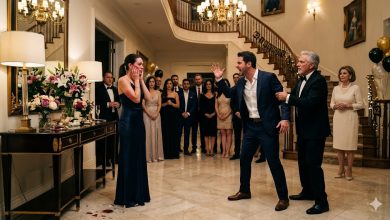
My uncle was released from prison, and everyone in the family closed their doors to him—except my mom, who embraced him as if someone else had caused it all.
“Ramiro… come out of there.”
My dad did not sound drunk.
That was the first thing that froze me completely.
At home, when he argued, his voice would shake and drag. He always smelled like beer and defeat. But in that dark factory hallway, his voice sounded steady, cold, and almost polite.
It sounded like the real Arthur Maldonado had just arrived.
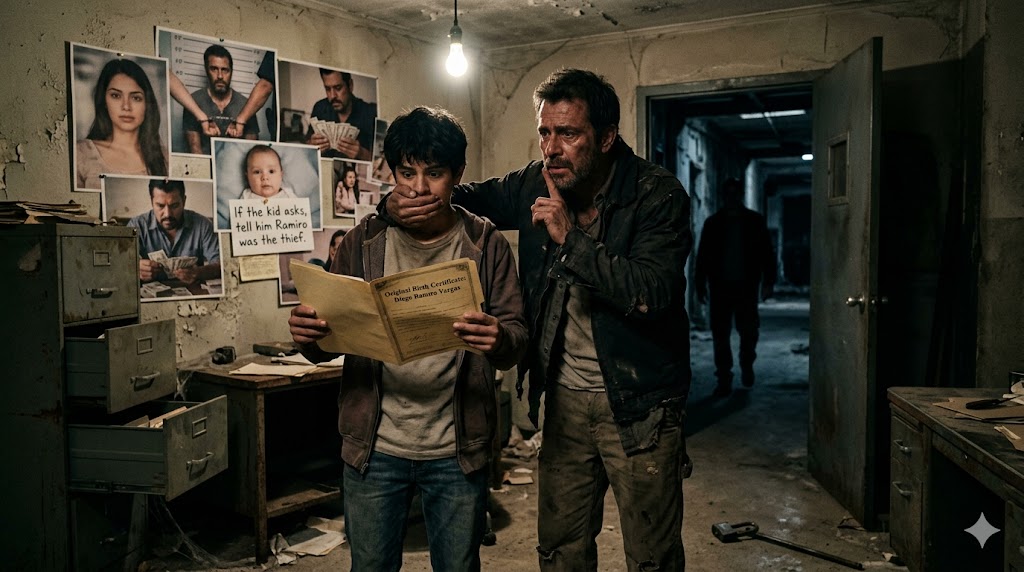
My uncle quickly pushed me behind a rusted metal filing cabinet.
“Don’t move,” he whispered. “No matter what happens, do not let go of that folder.”
I pressed the papers tight against my chest.
The single lightbulb flickered over the photos on the wall. My mom when she was young. Ramiro in handcuffs. My dad counting cash. Me as a baby with that terrible note:
“If the kid asks, tell him Ramiro was the thief.”
The heavy footsteps stopped right outside the office door.
“I know you’re in there with him, Diego,” my dad called out. “Come out, son. Don’t let that criminal put lies in your head.”
Ramiro walked out into the open first, raising his hands.
“Don’t call him your son as if you don’t know what you did.”
My dad stepped into the room.
He was holding a gun.
Behind him came a thin man in a gray suit, wearing glasses and carrying a black briefcase. I recognized him right away. It was Mr. Salas, the lawyer who had brought the foreclosure letters to our house in Detroit.
He was the same man who had told my mom: “Ma’am, if you don’t pay this week, the bank will take the house.”
Now I realized it was never really about the bank.
“Give me the folder, kid,” Salas said.
I didn’t move.
My dad pointed his gun directly at Ramiro. “Don’t do anything stupid. You already ruined your life once.”
Ramiro let out a tired laugh.
“No. You ruined it for me when you killed Aurelio.”
Aurelio.
My grandfather.
My mom’s father.
The man everyone told me had died of a heart attack before I was old enough to remember him.
“Shut up,” my dad snapped.
But his hand was shaking.
And that shook me more than the weapon itself.
“You killed my grandfather?” I asked from behind the filing cabinet.
All three of them turned toward me.
My dad’s face completely changed when he saw me. He quickly put his caring father mask back on. “Diego, come with me.”
“Answer me.”
“You don’t know what you’re talking about.”
Ramiro took a step toward me.
“Your grandfather found out that Arthur was stealing money from the company. He forged signatures, took out fake loans, and hid payments. Vargas Shipping belonged to your mother, Diego. It never belonged to the Maldonados.”
Salas spoke up: “You can’t prove that.”
Ramiro pointed straight at the wall.
“That’s why he kept copies. Aurelio wasn’t stupid.”
My dad clenched his teeth.
“The old man was going to ruin everything anyway.”
“No,” Ramiro said. “He was going to go to the police.”
The old factory creaked in the wind. Outside, a passing truck made the broken windows rattle.
“That night,” Ramiro went on, “Arthur beat him right here in this warehouse. Then he made it look like a robbery. He put my jacket near the safe, put blood on my clothes, and paid a guard to tell everyone he saw me leave.”
“The guard almost died,” my dad argued.
“Because you paid him to lie, and then you tried to kill him when he asked for more money.”
Salas raised his voice angrily.
“Enough. Arthur, finish this now.”
My dad looked at me. “Diego, you are a Maldonado. I raised you. I gave you a roof over your head.”
“Then what about my birth certificate?” I held up the yellow folder. “Why does it say Ramiro Vargas?”
His silence told me everything before he could even speak.
I felt sick to my stomach. “Is he my dad?”
Ramiro closed his eyes.
My dad smiled with pure hatred.
“Good job, Ramiro. You’ve gone and messed up his head.”
“No,” my uncle said. “You’ve been filling his head with lies since the day he was born.”
I looked over at Ramiro.
The man who lived in our tin shed.
The prisoner everyone called a thief.
The man who secretly gave me half his food when he thought I wasn’t looking.
“Are you my dad?” I asked again.
This time, he gave me an answer.
“Yes, Diego.”
Something broke completely inside me.
It wasn’t a sudden rush of love.
It wasn’t a feeling of relief.
It felt like someone had ripped up the floor beneath me and exposed all the dark years buried underneath.
My dad stepped toward me. “Give me those papers.”
I backed away.
Salas moved faster. He reached out to grab the folder from my hands, but Ramiro shoved him back. My dad raised the gun. I screamed.
The loud gunshot echoed through the small office.
Ramiro crashed against the desk.
For a second, I thought he was shot in the chest.
Then I noticed the blood soaking his shoulder.
“Ramiro!”
I didn’t call him uncle.
I didn’t call him dad.
I just yelled his name.
I grabbed a heavy wrench from the floor and threw it with all my strength. It hit my dad right on the wrist. He dropped the gun, and it slid away under a chair.
Salas tried to run out.
He didn’t make it far.
The office door burst open, and two police officers in vests rushed in, followed by a woman in a dark suit.
And right behind them walked my mom.
Her face was completely pale, but her eyes looked steady and determined. “It’s over, Arthur,” she said.
My dad froze. “Clara…”
“Don’t call me that.”
I had never heard my mom speak to him with such a calm, cold voice.
The woman in the suit held up a phone. “District Attorney’s office. We recorded part of that conversation. Nobody move.”
Salas immediately put his hands up. “This is just a misunderstanding.”
Ramiro held his bleeding shoulder and let out a bitter laugh. “For twenty years you called the truth a misunderstanding.”
My dad glared at my mom. “You did this.”
She took a step forward. “No. You did this. I just finally stopped hiding it.”
Then I looked at her. “You knew?”
My mom broke down. “Yes.”
The word hurt me like another gunshot. “You knew Ramiro was my dad?”
She cried openly. “Yes.”
“And you let me believe he was a thief?”
My dad yelled out: “Because I would have taken him away from you!”
The police grabbed him.
He struggled against them.
“I gave you everything! That house, that name, that life!”
My mom replied: “You gave us nothing but fear. Everything else, you stole.”
The yellow folder was handed over to the District Attorney’s office that very night. Ramiro was taken to the hospital with a police guard. I sat in a cold room at the station, my hands still stained with his blood and my mind spinning with questions that only hurt more to ask.
My mom sat down next to me. “Forgive me, son.”
I couldn’t look at her. “Why did you marry him?”
It took her a long time to answer.
“Because your grandfather was dead, Ramiro was in prison, I was pregnant with you, and Arthur threatened to kill him inside the prison if I said a single word. He told me he would snatch you away from me, too. Everyone believed him. Nobody believed me.”
“Ramiro did.”
“Ramiro was locked away behind bars.”
I covered my face with my hands.
For years, I thought my mom was weak for letting my dad treat Ramiro so badly. Now I understood she was living every day next to a ticking bomb.
If she spoke up, Arthur would destroy Ramiro.
If she stayed quiet, she destroyed me.
And even so, the moment he got out of prison, she was the only one who ran out to hug him. She was the only one who knew the real criminal was sitting at our dinner table.
The investigation uncovered the whole truth slowly.
It didn’t happen like it does in movies. There wasn’t one big piece of evidence that saved the day.
Instead, it was found through yellowed old papers. Through damaged audio recordings. Through matching signatures. Through tracking down an old guard in another state, who finally admitted that Arthur had paid him to lie about Ramiro.
They found old receipts. They found copies of property deeds that my grandfather Aurelio had hidden behind a fake wall.
The business had been called Vargas Shipping before Arthur changed the name. My mom was the actual owner. Ramiro had worked there, and he was engaged to her.
I was born while he was locked away.
Arthur registered me as his own son using fake documents made by Salas and a worker at the records office who had died long before any of this came to light.
My fake birth certificate didn’t just steal my real last name. It gave Arthur total control over my mother’s money and property.
The house in Detroit wasn’t lost after all. The foreclosure was stopped when the state found out the housing debt came from bank loans signed with forged paperwork. My dad’s—or rather, Arthur’s—workshop was also taken away for review. So many things we thought belonged to us were actually stolen.
Ramiro came back from the hospital with his arm wrapped in bandages. He didn’t want to sleep in the tin shed anymore.
My mom wouldn’t let him anyway. “That room is gone for good,” she said.
We set up a bed for him in the living room while we fixed up the extra bedroom in the back.
At first, I didn’t know how to talk to him. I would look at him and see two different people at the same time. The quiet uncle from the backyard, and the stolen father I never knew.
He didn’t push me. He didn’t force me to call him dad, and he didn’t demand love that I hadn’t given him over the years. He just kept me company.
When I went back to finish high school, he would wait for me outside the building with hot coffee and a sandwich wrapped in a napkin.
“You don’t have to love me right away,” he told me one night. “I learned how to love you from far away. I can wait for you from up close.”
That sentence broke my heart. Because he didn’t say it to complain; it just came from a deep, patient love.
The trial against Arthur lasted for years.
Justice moves very slowly when the criminal has connections, hidden money, and people who are terrified of him. Salas tried to make a deal to save himself. He gave the police other names—a notary, two illegal money lenders, and a retired police captain who had helped close Ramiro’s case way too fast.
My grandmother died before she ever asked Ramiro for forgiveness.
At her funeral, my cousins walked up to us with apologetic looks on their faces. “We didn’t know,” they said.
My mom looked right at them. “You didn’t know because you never bothered to ask.”
Nobody said another word.
Ramiro stayed outside the church during the service. He sat on the curb, staring down at his new shoes like he was still waiting for someone to yell at him to leave.
I went out and sat down next to him. “Aren’t you going inside?”
“Sometimes you’ve already buried people long before their hearts stop beating,” he said quietly.
I didn’t know what to say to that. I just handed him a bottle of water. He took it, and that was enough.
Arthur was finally convicted of fraud, forgery, grand theft, and several other crimes. We couldn’t legally prove how my grandfather Aurelio died because too much time had passed and the evidence was gone. But the old police file was reopened, and Arthur’s name was permanently ruined.
That didn’t bring back the last twenty years. It didn’t give my mom her youth back. It didn’t return the birthdays Ramiro spent in a prison cell, and it didn’t give me back my childhood.
But it gave us something Arthur never wanted us to have: a version of our lives where his voice no longer made the rules.
We got back part of the property in Flint.
The old factory was completely ruined, full of water damage, rats, and bad memories. We sold off one section of the land to pay off our actual debts. With the other section, we opened a small repair shop for trucks and vans.
It wasn’t fancy or huge. But the new sign out front read: Vargas Shipping.
The very first time we hung it up, it was a little crooked.
“I’ll fix it,” I said, reaching for the tools.
Ramiro shook his head. “Leave it. That way everyone can see it survived the storm.”
My mom laughed from the front doorway. Hearing that laugh was the first real sign that our home was finally starting to breathe again.
When I turned twenty-two, I officially fixed my birth certificate.
I didn’t erase the life I had lived, because you can’t rip away your past without hurting yourself. But I added what had been stolen from me. My legal name became Diego Ramiro Vargas Clara.
When Ramiro saw the new document, he touched the letters gently with his fingers, the same way someone looks at a photo of a loved one who passed away.
“Your grandfather Aurelio would have cried,” he whispered.
“And what about you?” I asked.
He wiped his nose. “I just have an allergy to government paperwork.”
I laughed, and then I hugged him tightly.
He froze up at first, totally surprised. Then he completely melted. He cried on my shoulder like a man who had been holding his breath for twenty long years.
“Dad,” I told him.
And that one simple word brought more real justice than a dozen court hearings ever did.
Today, I am thirty years old. I am a lawyer now. Not the kind you see on television commercials.
I work with regular families who walk into my office with endangered homes, stolen inheritances, fake certificates, and relatives who talk about love while planning a betrayal behind their backs.
Every single time a client tells me, “I don’t have proof, I only have my memories,” I think back to that dusty office in Flint. I think of my baby photo, the note taped to it, the yellow folder, and Ramiro bleeding from a gunshot while telling me never to let go of those papers.
My mom and Ramiro live together happily now.
They didn’t throw a massive party or look for anyone’s approval. One Sunday, I walked in and found them dancing together in the kitchen with the radio turned down low, surrounded by the smell of home cooking and the mint growing in the yard.
They didn’t look like young people trying to catch up on lost time. They looked like two survivors who were finally learning how to sit down without being afraid.
The relatives who had slammed their doors on Ramiro tried to come back around later on. They came with apologies, excuses, and phrases like “we had no idea” and “it was so long ago.”
Ramiro didn’t look for revenge. He just didn’t open his heart to them again.
I learned a valuable lesson from him: forgiving someone doesn’t mean you have to hand them the key to your life again. Sometimes it just means letting go of the anger, but changing the lock on the door.
The night we thought we were going to lose our home, my uncle had said: “Come on. I’m going to show you why they really locked me up.”
I went with him thinking he was going to show me a crime he committed. Instead, he showed me an entire fake life created by a criminal. He showed me that a thief doesn’t always walk out of prison holding a black trash bag.
Sometimes the real thief is sitting right in your living room, calling himself your father, counting stolen cash, and claiming he protects the very family he is keeping hostage with lies.
My uncle got out of prison, and everyone shut their doors on him. My mom was the only person who ran to hug him. For years, I truly believed she was hugging a guilty man.
Now I know she was hugging the only innocent man in our lives—a man who willingly let the whole world hate him just so I could stay alive.
And when I finally called him dad, Ramiro Vargas—the man everyone pointed at, the prisoner, the guy from the tin shed, the man who never defended himself because doing so could have cost us our lives—cried like someone who, after twenty years of waiting, was finally given back his rightful place at the front door of his own home.