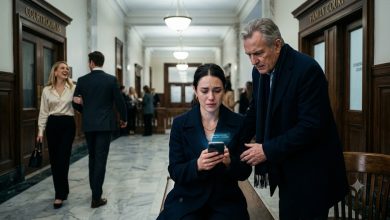
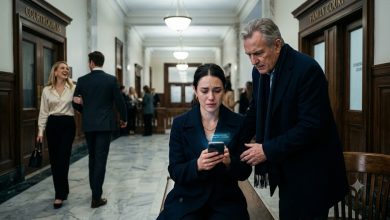
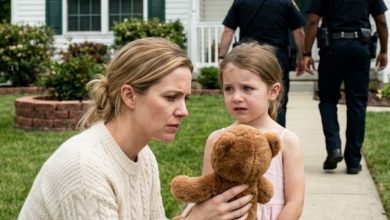
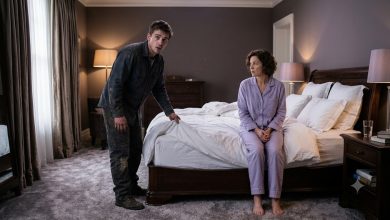
My mother spent seven years praying to my dead sister. Yesterday, I saw her alive on national television… claiming that a man had kidnapped her.
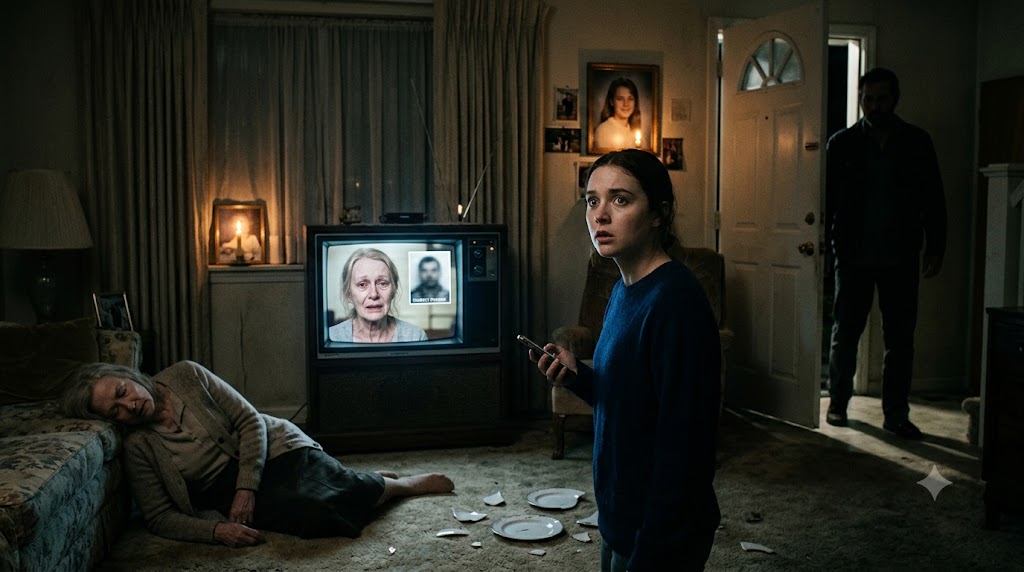
My mother spent seven years praying to my dead sister. Yesterday, I saw her alive on national television… accusing a man of kidnapping her. When they showed the photo of the suspect, my mother fainted. It was my father.
In our house, there was a room that no one touched.
The door remained closed.
The bed remained made.
The trophies remained on the shelf.
And the photograph of my sister remained hanging on the wall as if she were still a teenager.
According to the police, Valeria had died seven years ago.
One night, she left the house.
She never returned.
Months later, human remains were found buried in a rural area.
We were told the tests matched.
They gave us an urn.
There was a funeral.
There were tears.
There were eulogies.
And there was something else.
Too much haste.
My father was the first to insist on ending everything.
“Let her rest.”
That phrase became law.
No one could ask questions.
No one could investigate.
No one could mention the case.
My mother obeyed.
But she never stopped crying.
For seven years, she spoke to a photograph every night.
For seven years, she kept a candle lit by the window.
For seven years, she waited for a miracle that never arrived.
Until yesterday.
I was eating dinner in front of the television when a special report came on.
A woman had just escaped after being held against her will for years.
The news was on every channel.
The anchor introduced the victim.
And then, the plate fell from my hands.
It was Valeria.
My sister.
Thinner.
Older.
But alive.
My heart stopped beating.
My mother heard the noise and came running from the kitchen.
“What happened?”
I couldn’t answer.
I just pointed at the screen.
She saw the face.
And let out a scream that still wakes me up at night.
Because the dead do not appear on television.
The dead do not give interviews.
The dead do not look into cameras with tears in their eyes.
But Valeria did.
She was alive.
And she was speaking.
She said she had been in hiding for years.
She said she had escaped just two weeks ago.
She said someone very powerful had helped her disappear.
Then, the journalist asked the question.
“Who was responsible for all of this?”
Valeria looked directly into the camera.
And replied:
“The man everyone believes is a good person.”
My mother began to tremble.
I did, too.
Because we knew that look.
It was the same one she had when she was terrified.
Then, a photograph appeared.
The alleged perpetrator.
The person she was pointing to.
My mother collapsed before I could catch her.
Because the man in the photograph was my father.
The same man who had accompanied us to the cemetery for seven years.
The same man who cried at the funeral.
The same man who told us to accept the loss.
And while I was calling an ambulance, my phone vibrated.
Unknown number.
I answered.
On the other side, I heard ragged breathing.
Then a voice I would recognize among millions.
“It’s Valeria.”
I felt my legs give out.
“Where are you?”
She began to cry.
“I don’t have time.”
“What happened?”
“Dad already knows I spoke out.”
I looked toward the living room.
My father had just walked through the front door.
And in that instant, I heard my sister whisper:
“If he arrives before you at the place I’m about to tell you… you will never know who the person really was that died at my funeral…”
My father had just walked through the door when my sister uttered that last sentence.
The call cut off before I could ask her where she was. I put my phone away, trembling, while the paramedics tended to my mother, who remained unconscious on the living room floor. My father ran toward her, feigning concern and asking what had happened.
My whole life, I would have believed that performance. That night, I no longer could.
As he hugged my mother and demanded answers, I still had the image in my head that had just appeared on television: Valeria’s face, pointing directly at him as the man responsible for her disappearance.
I couldn’t confront him there. If he had really kept my sister captive for seven years, he was capable of anything to silence her again. I pretended to be just as confused as he was and accompanied my mother to the hospital without mentioning the call.
When my mother woke up several hours later, the first thing she did was look for my father. He was gone. He had said he was going to speak to the police to clear up the “madness” Valeria was spewing on television.
As soon as we left the room, my mother gripped my hand tightly. She had spent seven years crying in front of a grave, and yet, she confessed something she had never told me before: she never fully believed the evidence that identified those remains. It had always seemed strange to her that the authorities handed over an urn without letting them see the body.
She also recalled that the file disappeared from the district attorney’s office a few weeks after the funeral and that my father insisted on changing lawyers when she wanted to reopen the case. At the time, she thought he was just a man trying to protect his family from pain.
Now, she understood he might have been protecting himself.
While we were talking, a new message arrived on the phone. It was a location sent from an unknown number along with a very brief phrase: “Come alone. Trust only Mom.” My mother immediately recognized the place.
It was an old vacation house my grandfather had bought decades ago on the outskirts of Asheville, North Carolina. It had been abandoned for years and officially belonged to a company that no longer existed. We decided to go without telling anyone.
Before leaving the hospital, my mother discreetly called an old friend who worked at the district attorney’s office and asked her to review the original file regarding Valeria’s disappearance. The woman agreed to help us, though she warned that several documents had been altered over the years.
We arrived at the house shortly before dawn. The door was unlocked. Everything seemed empty, but on the dining room table, we found a folder containing photographs, notebooks, and several USB drives. Then, Valeria appeared.
She was much thinner than we remembered, with visible scars on her arms and her face marked by years of confinement. My mother ran to hug her through tears while I could barely believe she was really in front of us.
After a few minutes, she managed to explain the whole truth. The night she disappeared, she accidentally discovered that our father was using various companies to launder money for a criminal organization. When she tried to report him, he decided to make her disappear.
He never intended to kill her because he needed her to remain alive to force her to sign documents and move money using a false identity.
With the help of corrupt individuals, he faked her death using human remains belonging to a woman who had never been identified. The DNA tests were altered by an expert who mysteriously disappeared years later.
For seven years, they kept her moving between houses and names, constantly watched, until a police raid allowed her to escape along with other victims.
But Valeria wasn’t done yet. She opened the last folder and showed me something that finally destroyed everything I thought I knew about our family. There were bank records, deeds, recordings, and a series of letters written by our father many years earlier.
In them, he acknowledged that it had all started even before the disappearance. For years, he manipulated our mother, making her believe that various family businesses were legal, when in reality, he had spent decades building a fortune through financial crimes.
Valeria was never kidnapped by a stranger. She was turned into a prisoner by the man who was supposed to protect her.
The evidence provided by Valeria was sufficient for the district attorney’s office to officially reopen the case. For weeks, we gave statements over and over again while specialists analyzed documents, recordings, and financial transactions.
My mother’s friend managed to recover part of the original file and discovered that several pages had been replaced just days after the supposed funeral. A forensic report that had never been incorporated into the process also surfaced, stating that the remains found could not be identified with certainty.
Even so, someone had ordered the investigation closed in a hurry. That haste that had baffled us for years had a very simple explanation: they needed Valeria to be legally dead so that no one would keep looking for her.
My father fled when he learned the investigation had been reopened. He remained in hiding for several weeks until he was located in a property registered under the name of a shell company.
There, they found forged documents, cash, and enough evidence to prove he had run a complex concealment network for years. Several people were arrested along with him, including officials who had participated in tampering with the file and the genetic analysis.
They also finally managed to identify the woman whose remains had been used to fake my sister’s death. She was a person who had been missing for years, whose family had never received any answers.
Thanks to the reopening of the case, they were able to recover her true identity and give her a dignified burial.
Valeria’s recovery was much slower than any judicial process. Seven years of confinement do not vanish when a door opens. She needed therapy, medical attention, and a long time to learn to trust other people again.
My mother never stopped being by her side. For years, she had prayed in front of a photograph, believing she was talking to a dead daughter. Now, she could hug her, although both knew neither would get back the time lost.
I also had to learn to rebuild my life. Understanding that the man I had admired for so many years was capable of destroying his own family was a wound that was difficult to accept.
However, looking at my sister alive every morning reminded me that the truth, however painful, was always better than a comfortable lie.
As time went by, we turned that room that remained closed for seven years into something completely different. We took away the dried flowers, put away the empty urn, and removed the portrait that had presided over our fake mourning for so long.
Valeria decided to keep only one photograph from when we were children, before fear entered our home. She said she needed to remember that there was a time when we were still a family, even if it had lasted only a short while.
This whole story left me with a lesson I will never forget. The pain of losing someone is immense, but it is even more dangerous to accept a truth without asking questions just because the person telling it is someone we trust.
For seven years, we wept in front of a grave that never belonged to my sister. It only took one lie, repeated by the right person, to destroy an entire family.
That is why I understood that true love does not consist of believing blindly, but also in having the courage to seek the truth when something does not add up, even if that truth ends up completely changing the story of our own life.