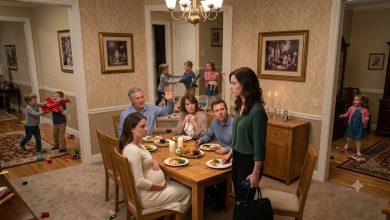
Part 2 – The Firefighters Insisted My Daughter Wasn’t in the Burning House — Then Our Dog Appeared, Dragging Her Out by the Collar
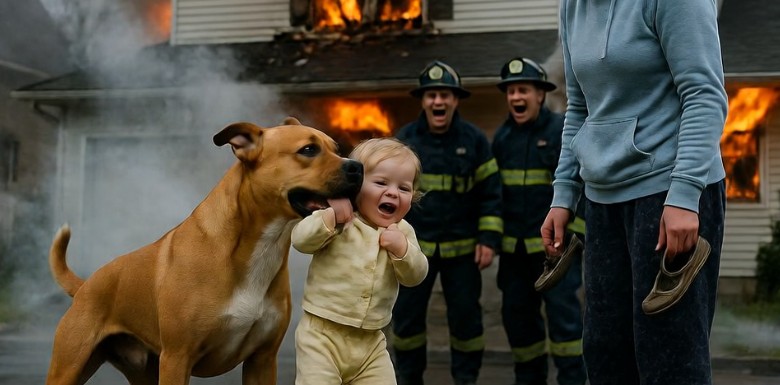
The Firefighters Said My Daughter Wasn’t Inside the Burning House — Then Our Dog Came Out Dragging Her by the Collar
Part 2 — Rising Action
Before the fire, Mabel was the kind of dog people avoided on the street.
It was not because she had ever hurt anyone. She never had. But she was a Pit Bull in a neighborhood where fear moved faster than facts. Some people only needed to see her wide head and strong shoulders to decide she was dangerous.
Caleb brought her home three years before he died. He found her behind Station 18 after a thunderstorm. She was wet, skinny, and guarding a cardboard box filled only with towels. He called me from the fire station and said, “Nora, don’t get mad yet.”
That was how most of our trouble started.
I was six months pregnant with Lily, tired all the time, and not looking for a rescue dog with scars on her legs and eyes that watched every door. But Caleb knelt next to her in our kitchen. He held out a piece of turkey and waited twenty minutes until she took it from his hand without shaking.
“She’s not broken,” he said. “She’s just listening for the part of the world that won’t hurt her.”
That was Caleb. He talked about scared things as if they were people who had lost their way home.
Mabel became his shadow first.
She slept next to his boots. She waited at the window when his work shift ran late. When he came home smelling of smoke, rain, and metal, she pressed her nose into his jacket as if checking him for missing pieces.
When Lily was born, I worried Mabel would be jealous. Instead, she spent the first week lying outside the nursery door with one ear up and one ear down. She looked like a small guard waiting for permission to enter the room.
The first time Lily cried hard, Mabel brought Caleb’s sock and dropped it next to the crib.
It wasn’t a toy.
It was a solution.
Caleb laughed so loudly he woke the baby up again.
“She thinks my feet fix things,” he said.
As Lily grew, Mabel became part babysitter, part pillow, and part silent alarm. If Lily crawled too close to the porch steps, Mabel blocked her with her body. If Lily reached for a hot mug, Mabel nudged her hand away. If Lily hid during a thunderstorm, Mabel found her before I did.
That last part seemed small back then.
It was not.
Lily’s hiding started after Caleb’s funeral.
At first, she hid behind the couch when neighbors brought food. Then she hid under the dining table when someone said her father’s name. By the time she turned four, she had made the closet under the stairs her safe place.
I hated that closet.
It smelled like dust and old winter coats. There was barely enough room for a child to sit with her knees pulled up. But Lily loved it because Caleb had once played flashlight games with her there during a power outage. After he died, she taped his picture to the inside wall, right above the small wooden stool where she sat with her stuffed rabbits.
Mabel knew.
Of course she knew.
Every time Lily vanished, Mabel would stand outside that closet and hit her tail once against the floor.
One knock.
Then she would wait.
She didn’t scratch or whine. She just waited until Lily opened the door and wrapped both arms around her neck.
I should have noticed the pattern.
I should have noticed how Mabel always checked the closet first.
There were other things too.
Little things that looked like habits but were actually warnings wearing ordinary clothes.
Mabel hated the old dryer vent in the laundry room. She would sniff it, sneeze, and back away. She refused to sleep in the hallway after Caleb died, choosing instead to lie between Lily’s bedroom and the kitchen. Once, in January, she barked at the smoke alarm before it even chirped, staring at the ceiling until I changed the battery.
I told people she was just dramatic.
Caleb would have called her observant.
After he died in a warehouse collapse, I changed in ways I did not want to admit. I stopped cooking real dinners. I forgot to pay bills. I let laundry pile up until it smelled sour. I sold Caleb’s truck because seeing it in the driveway felt like getting the bad news twice every morning.
And one night, after Mabel accidentally knocked over a stack of folded clothes while chasing Lily through the hallway, I shouted, “I can’t deal with you too!”
Mabel went totally still.
Lily cried harder than the dog did.
Two weeks later, I filled out an online form to give Mabel away to a rescue group.
I never sent it.
But I filled it out.
That is a fact I carried like a heavy stone after the fire.
Because on the morning our house burned, the dog I thought might be too much for me became the only one who knew where my child had gone.
Part 3 — False Climax
The fire started in the laundry room.
That was what the first report said.
It was an electrical problem behind the dryer, inside the wall. The flames climbed fast, burning through old insulation and the wood frame of a house built in 1957. It was built long before anyone imagined a family like ours would live there with a rescue dog, a grieving mother, and a child who hid when things got loud.
I woke up to Mabel hitting my bedroom door.
She wasn’t barking.
She was hitting it.
Her front paws slammed against the wood again and again until the sound woke me up. At first, I thought Lily had fallen out of bed. Then I smelled smoke.
There are smells that do not need an explanation.
Smoke in a house is one of them.
I opened the door and Mabel ran past me toward Lily’s room. The hallway light flickered. A gray-black cloud pressed against the ceiling and rolled down like something alive. I remember yelling Lily’s name, but the smoke took my voice away.
Lily’s bed was empty.
Her pink blanket lay twisted on the floor.
The window was closed.
I ran to the closet under the stairs, but heat rushed from the back hall, and smoke burned my eyes so badly I could not see the handle. Mabel was next to me, barking now, deep and sharp, pointing her body toward the closet door.
Then the kitchen window exploded.
The sound broke the house open.
I stumbled back.
Someone outside screamed my name. A neighbor, Mr. Ellis, came through the front door with a wet towel over his mouth and grabbed my shoulders. I fought him. I remember his hands under my arms, the porch steps under my feet, and the cold air hitting my face like a slap.
“My daughter,” I kept saying. “My daughter is inside.”
He held me in the yard while smoke poured from the roof and sirens came closer.
The firefighters arrived in less than four minutes.
Four minutes can feel like a lifetime when your child is trapped in smoke.
I told them about Lily’s room. I told them about the closet. I told them she hides. I said it again and again until one firefighter put both hands on my shoulders and said, “Ma’am, we hear you.”
They went in through the front.
Two firefighters came out carrying nothing.
One went back inside.
Then another.
The flames had pushed into the hallway by then. The laundry room wall was burning through. The side door crashed inward, sending sparks and smoke into the air.
I saw Mabel at the broken door once.
Just once.
A firefighter shouted, “Get that dog out!”
But she turned away from him and disappeared back into the smoke.
That image stayed with me longer than any flame.
Her tail disappeared first.
Then her back.
Then nothing.
A captain told the crew to pull back. The house was becoming too unsafe. They had searched the visible rooms. They had checked where I told them to look. They had not found Lily.
I heard a firefighter say, “No victim found.”
The words did not feel real.
I stepped toward the house.
Someone caught me.
Then Mabel came out.
She was low to the ground.
She was dragging Lily.
The entire street changed in a single breath.
Men shouted. Boots ran. A paramedic dropped to his knees. Mabel pulled until Lily’s shoulders were outside, then she let go and collapsed next to her. Her nose was still pressed to the little pajama collar, as if she wasn’t sure the job was finished.
Lily coughed.
Just once.
Small.
Wet.
Alive.
The paramedic said, “We’ve got a pulse.”
And I thought the story ended there.
My daughter lived.
My dog saved her.
The fire took the house, but not my child.
For one bright, beautiful second, that felt like enough.
Part 4 — The Twist
It was not enough.
Two days later, while Lily slept with oxygen tubes at the children’s hospital, a fire investigator named Marsha Greene came to see me. She was in her late fifties, with short silver hair and a calm voice that made every sentence feel very heavy.
She asked if we had enemies.
I almost laughed.
Not because it was funny, but because my life had become so simple that enemies felt too dramatic. I was just a woman who packed preschool lunches and forgot to buy paper towels.
“No,” I said.
She nodded, wrote something down, and then asked about the smoke alarms.
I told her they worked.
She asked if I was sure.
I remembered the one in the hallway chirping in January. Mabel staring at it. Me changing the battery while Lily covered her ears.
“Yes,” I said. “I’m sure.”
Marsha looked at me for a long time.
“The alarm closest to the laundry room had no battery in it.”
That sentence opened a door in me I did not want to walk through.
“What do you mean?”
“I mean the battery was taken out.”
I thought of my own tired hands. The nights I walked through the house half-awake. The drawers full of loose batteries, rubber bands, receipts, and Caleb’s old fire station pins. Had I taken it out? Had the chirping started again? Had I meant to replace it and forgotten?
Grief makes people forget things.
I was ready to blame myself.
Then Marsha placed a clear evidence bag on the table.
Inside was a small object, burned black but still recognizable.
It was a childproof outlet cover.
It was melted on one edge.
“We found this stuck behind the dryer,” she said. “And we found scrape marks on the laundry room floor, like something had been moved recently.”
I stared at the bag.
“I don’t understand.”
“We’re not calling it a crime yet,” she said. “But the fire did not just start in the wall. Something was blocking the airflow behind the dryer. Lint, clothes, or maybe paper. The dryer had been pushed much closer to the wall than it should have been.”
I closed my eyes.
Mabel hated the dryer vent.
Mabel had been warning us.
But that was not the real twist.
The real twist came that afternoon, when Mr. Ellis brought me a plastic grocery bag from what was left of our front yard. The firefighters had found a few items near the porch, soaked and covered in soot. He thought I might want them.
Inside was Caleb’s old firefighting glove.
I had not seen it in months.
After his funeral, I packed most of his gear into the attic because Lily kept sleeping with his helmet and waking up crying. The glove should not have been downstairs.
But it had been found near the closet.
The closet where Lily hid.
The closet where Mabel found her.
When Lily woke up later that evening, her voice was thin from smoke and fear. I held a cup of water to her lips and asked a question I had been afraid to ask.
“Baby, why did you go into the closet?”
She looked toward the corner of the room, where Mabel lay on blankets with bandaged paws and a shaved patch on her shoulder.
“Daddy said stay low,” Lily whispered.
My chest tightened.
“What?”
“In the smoke,” she said. “Daddy said stay low and wait for Mabel.”
I thought it was just a dream.
Children say strange things after scary events. Adults do too.
But Lily kept talking.
She said the smoke alarm did not wake her up. Mabel did.
Mabel jumped on her bed, pulled her blanket, and pushed her with her head. Lily got scared when the hallway turned dark. She ran to the closet because that was where Daddy’s picture was, and because Daddy had taught her to crawl there during their flashlight game.
Then she said something that made the room tilt.
“Mabel had Daddy’s glove.”
I looked at the dog.
Mabel raised her head.
Her eyes met mine.
Caleb had not just rescued a stray dog years ago.
He had trained her.
He didn’t do it officially. There were no certificates, no paperwork, and no commands anyone else knew. He had trained her in our house, with our child, inside the little games I thought were just his way of making Lily laugh.
Find Lily.
Stay low.
Bring help.
Use the collar.
I remembered Caleb crawling across the living room floor with Lily giggling on his back while Mabel followed with a sock in her mouth. I remembered him saying, “If the house ever gets smoky, we don’t stand tall like grown-ups. We become turtles.”
I had laughed from the kitchen.
He had been teaching them both.
And after he died, Mabel remembered every single lesson.
Part 5 — Revelation
The week after the fire, pieces of memory kept coming back to me out of order.
Small memories.
Ordinary ones.
The kind a tired mother ignores as regular house noise, until tragedy shines a light on them.
Caleb used to tug gently on the back of Lily’s pajama collar during their games. He would pull her backward across the rug while she screamed, “Again, Daddy, again!” I would tell him not to stretch her shirts, and he would smile and say, “Better a stretched collar than a scared kid who won’t move.”
Mabel was always right next to them.
Watching.
Learning.
Waiting for her turn.
Sometimes Caleb would hand Mabel a towel and say, “Soft mouth.” She would carry it across the room without tearing it. Then he would switch to one of Lily’s old shirts. Then a hoodie. Then the back of a jacket while Lily crawled on her hands and knees, laughing too hard to be afraid.
I thought it was just play.
It was practice hidden inside love.
I remembered another night, six months before Caleb died, when thunder knocked out the power and Lily screamed from the hallway. Caleb lit a flashlight and turned the closet under the stairs into a “safe cave.” He taped his picture there as a joke, saluted it, and told Lily, “If you ever get scared, go where the light is low and wait for your team.”
“Who’s my team?” Lily asked.
Caleb pointed at me.
Then he pointed at Mabel.
Then at himself.
“Always us.”
After the funeral, I wanted to tear that picture down because seeing his face in a closet hurt too much. But Lily begged me not to. Mabel sat in front of the door and refused to move until I lowered my hand.
I thought the dog was just being stubborn.
She was guarding the map.
The investigator’s report later confirmed the fire moved faster because the dryer had been pushed against the vent, and a pile of old lint had trapped the heat. Nobody meant to start it. There was no enemy. No crime. There was only an old house, a tired mother, a bad appliance, and one missing battery I may never forgive myself for.
But Marsha Greene said something I still hold onto.
“You got out because the dog woke you up,” she told me. “Your daughter got out because the dog went back inside. Without her, we would be having a very different conversation.”
Mabel spent nine days at the emergency vet.
Her burns were not the kind that made for dramatic news headlines, thank God. They were painful but she could survive them. Her paw pads were damaged from the hot floor. Her shoulder fur had to be shaved. Her throat was raw from the smoke. For three days, she would not eat unless someone brought one of Lily’s socks and placed it near her bowl.
The vet workers loved her.
One young man named Andre told me she kept trying to stand up whenever a child cried in the lobby.
“She thinks she’s on duty,” he said.
“She is,” I answered, before I even realized I believed it.
The story spread after a neighbor posted a photo online. In the picture, Mabel lay on a vet blanket with her brown fur cut unevenly, one ear folded, and eyes tired but clear. The caption called her a hero.
Then the comments came.
Some were kind.
Some were cruel.
People argued about her breed. People said Pit Bulls were dangerous. People said the photo was fake. People said a dog could not think that way.
I stopped reading after ten minutes.
Because I had seen her come through the smoke with my child’s collar between her teeth.
I did not need strangers to explain to me what loyalty looked like.
The biggest surprise came when we were allowed to visit the ruins of the house under supervision. Lily stayed with my sister, but I went with Marsha and Mr. Ellis to see what could be saved.
There was very little.
A few dishes.
A metal box of recipes.
Caleb’s wedding ring, which I had kept in a small bowl next to the bed, turned black by fire but still whole.
Then Marsha called my name from the hallway.
The closet under the stairs was damaged but not completely destroyed. Smoke had stained the walls. The stool was turned over. One stuffed rabbit had melted into the carpet. The other was missing.
But Caleb’s photograph was still taped inside.
Below it, scratched into the soot on the wall, were four lines.
They weren’t words.
They were claw marks.
Mabel had clawed at the door from the inside or the outside. Maybe both. She had tried to open it, failed, and then forced her body into the narrow opening after the heat bent the door frame. The marks were deep, frantic, and low to the floor.
Near the doorway lay Caleb’s firefighting glove.
Mabel must have taken it from the attic box days or weeks earlier and hidden it near Lily’s safe place. Maybe the smell comforted Lily. Maybe Mabel carried it there because she still connected Caleb’s scent with rescue. Maybe she had been rebuilding the same team after he was gone.
We will never know.
But Lily knew one thing.
When she saw Mabel again, she reached for the dog’s face with both hands and whispered, “You brought Daddy’s brave.”
Mabel closed her eyes and leaned into her.
That was when I finally understood the part I had missed all along.
Mabel did not replace Caleb.
She kept his memory moving forward.
Every command he gave with a laugh, every game he played on the living room rug, every quiet lesson he hid inside being a father—she carried it all when the rest of us were too broken to carry anything well.
She was not just a dog who ran into a fire.
She was a living piece of what Caleb had left behind.
A witness with paws.
A promise with teeth gentle enough to hold a child’s collar.
Part 6 — Echo
We moved into a rental duplex three miles from the old house. It was close enough that Lily still saw familiar streets, but far enough that she stopped asking why our porch was gone.
The first night there, she refused to sleep in her new room. I found her sitting in the hallway with a flashlight, two stuffed rabbits given to her by a nurse, and Caleb’s photo in her lap.
Mabel, still wrapped in soft bandages, lay down next to her with a careful sigh.
They both looked older.
That is something people do not tell you about survival. It saves your life, but it does not always return you exactly the same.
After the fire, we started a small ritual every Sunday morning.
At 6:42, not because I wanted to remember the hour everything burned, but because I wanted to claim that minute before fear could, I made toast with a lot of butter. Lily poured water into Mabel’s bowl using both hands. Then we sat on the kitchen floor together.
We didn’t sit at the table.
We sat on the floor.
Caleb used to say that smoke rises, and families should know how the floor feels before they actually need it. So we practiced breathing low, crawling to the door, touching handles with the backs of our hands, and saying our safe place out loud.
Front yard mailbox.
Neighbor’s porch.
Call 911.
Lily took it very seriously.
Mabel took it personally.
Even after she healed, she followed every single drill like a captain on four legs. If Lily crawled too slowly, Mabel nudged her. If I forgot to say “stay low,” Mabel barked once. If the smoke alarm test beeped, Lily covered her ears, but she did not hide anymore.
She reached for Mabel’s collar instead.
That became the new rule.
When you are scared, hold the dog, not the dark.
Mabel’s fur grew back unevenly along her shoulder, a lighter shade than before. The vet said it might always look different there. Lily called it her fire cloud and kissed it every night before bed.
I used to upset myself when people asked about the fire. Now, sometimes, I just tell them the truth.
The firefighters were brave.
The neighbors were kind.
The doctors were skilled.
But the one who knew where my child hid was the one who had listened every single day before anyone ever called it training.
The one who knew the closet.
The one who knew the collar.
The one who knew Caleb’s lessons by heart.
Part 7 — Ending
Six months after the fire, Station 18 invited us to a small ceremony.
I almost said no.
Ceremonies felt too much like funerals. I had already stood in that station once wearing black clothing, holding Lily while firefighters lined both sides of the room and Caleb’s helmet rested on a folded flag.
But Lily wanted Mabel to go.
So we went.
Mabel wore a soft blue bandana because a vest still rubbed her scarred shoulder. Lily wore a yellow dress and carried Caleb’s old glove in both hands.
The captain spoke for less than five minutes. He did not make it grand. He did not try to turn our pain into a big speech. He simply knelt in front of Mabel, placed one hand over his heart, and said, “Your partner trained you well.”
Mabel looked past him.
She looked straight at Caleb’s old locker.
The room went completely still.
Lily walked over, opened the locker door with some help, and placed the glove on the shelf inside. Then she took Mabel’s face in her small hands.
“You can rest now,” she whispered.
Mabel wagged her crooked tail once.
Only once.
That night, back in our rental kitchen, Lily fell asleep on the floor next to her. Mabel rested her chin gently over the back of Lily’s pajama collar. She wasn’t pulling this time. She was just holding the place she had once carried her from the smoke.
I turned off the light.
The house was quiet.
The alarm blinked red above us.
And my daughter breathed.
Follow this page for more unforgettable dog stories about courage, loyalty, rescue, and the quiet moments when an animal becomes the reason someone makes it home.