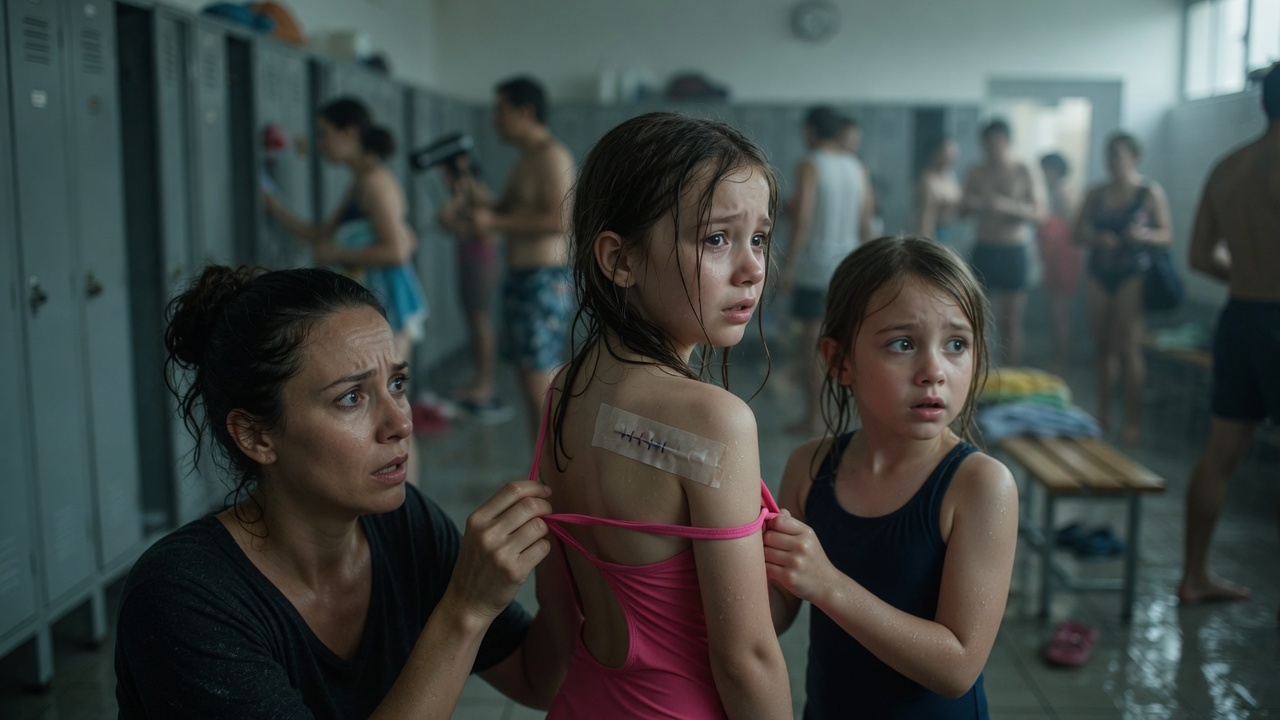
My sister asked me to babysit my niece for the weekend, so I brought her to the local pool with my daughter.
Eight minutes into our journey, a vibration rattled my phone.
Rachel: Turn around. Now.
I chose not to reply to her. Instead, I focused entirely on driving, gripping the steering wheel so tightly my knuckles turned pale, glaring at the gridlocked Boston traffic as though every red light were actively working against me. Harper sat in the backseat, completely mute—a silence that felt entirely unnatural for her. Right beside her, Sophie was pressed tightly against the door frame, anchoring herself to her damp towel with a desperate intensity, looking terrified that someone might rip it from her hands at any second.
The device vibrated once more.
Rachel: Don’t take her to the hospital. I can explain.
A freezing rush of heat surged up into my chest. Don’t take her. There was no inquiry of “What’s wrong?” No frantic “Is she alright?” Not even a basic “Tell me what she needs.” Only a stark command: Don’t take her.
That single message felt infinitely more sinister than the wound itself. More horrifying than the medical tape. More damning than Sophie’s terrified whisper confirming that her injury was no accident.
I stole a quick glance into the rearview mirror. Sophie kept her gaze locked firmly onto her knees. Harper was watching me with those massive, frightened eyes children get the exact moment they realize the adults around them have lost control.
“Mom?” Harper whispered softly.
“Everything is going to be fine,” I lied.
It wasn’t fine in the slightest. Nothing about this was okay. But I kept my voice perfectly level, and when a child is only seven years old, sometimes a steady voice is the only thing keeping them from falling apart for a few more minutes.
The silhouette of Boston Children’s Hospital eventually loomed at the end of the road like a stark, white sanctuary. I pulled straight into the emergency room drop-off lane, shifted into park, threw my door open, and guided both girls out onto the concrete. Harper immediately latched onto my left hand. Sophie, instinctively and without a word, gripped my right.
That silent connection nearly shattered me. Because a six-year-old child shouldn’t know how to seek protection like that. Not with such quiet, heavy desperation. Not with that kind of practiced instinct.
Approaching the triage desk, I offered the only coherent sentence I could manage: “I need my niece examined immediately. She has a fresh surgical incision, and I have absolutely no idea how it got there.”
The receptionist’s face hardened instantly. She swiftly guided us through the secure double doors, completely bypassing the mountain of intake paperwork and dropping her polite administrative demeanor entirely. Within five minutes, we were seated in a compact exam room with sea-foam green walls, peeling cartoon decals, and that distinct, sterile aroma belonging to places where pain hasn’t fully registered yet.
A young attending pediatrician, Dr. Sarah Jenkins, stepped into the room, accompanied by a nurse whose hair was bound in a tight bun and whose eyes were incredibly sharp and observant.
“I’m just going to take a very gentle look at you, Sophie, if that’s alright?” the doctor asked, her tone soft, addressing the little girl directly instead of looking at me.
I respected her immediately for that choice. Sophie didn’t give a verbal response. She just kept her eyes glued to the closed examination door. The doctor followed her line of sight.
“Nobody is walking through that door unless I say it’s okay, sweetie.”
At that, Sophie finally raised her gaze. “Not even my mommy?”
That brief question seemed to steal all the oxygen from the small room. Dr. Jenkins and I swapped a heavy, knowing glance. Without needing to be told, the nurse stepped backward and verified that the door was completely latched.
“Not even your mommy, especially if you don’t want her here,” the doctor promised gently.
Sophie swallowed nervously and gave a subtle nod. The subsequent medical examination was incredibly deliberate. Tender. Entirely agonizing to witness. As Dr. Jenkins meticulously pulled back the layer of surgical tape, a precise, clean incision came into view—fresh, dark sutures surrounded by a faint ring of inflammation. This wasn’t some makeshift, kitchen-counter patch job. This wasn’t an amateur first-aid attempt.
“This was undeniably performed by a medical professional,” Dr. Jenkins noted, her expression turning incredibly stern. “Are you aware of any recent medical procedures your niece has undergone?”
“No,” I answered, my hands trembling. “My sister never mentioned a single thing about it to me.”
The pediatrician redirected her attention to Sophie. “Sweetie, do you remember why the doctors had to do this to your back?”
Sophie stared down at her damp bathing suit resting on the linoleum tiles. “They told me it was so Mommy would stop crying all the time.”
I felt a sudden wave of dizziness wash over me. Dr. Jenkins maintained her professional composure, but I saw her shoulders lock up instantly beneath her scrubs.
“Who told you that, honey?”
Sophie nervously picked at the crinkly paper lining the examination table. “The man wearing the white coat. And Mommy told me that if I behaved like a good girl, it would make things much easier for everyone. She said I shouldn’t tell my aunt because she wouldn’t understand.”
Across the room, the nurse’s fingers were already flying across the computer keyboard. The doctor kept her tone completely calm and reassuring.
“Did it hurt?” Sophie gave a sorrowful nod. “Did anyone tell you what they were going to do before they did it?” She shook her head side to side. “Did you fall asleep for it?” “Yes… they put a mask over my nose that smelled really yucky.”
I had to grip the edge of the stainless-steel sink just to keep myself upright. The doctor looked back toward me, her eyes bearing the heavy expression of a professional who knows they are about to cross a line from which there is no return.
“I need to have a quick word with you out in the corridor.”
I stepped out behind her into the brightly lit hallway. Harper remained in the room with the nurse, who had produced an iPad out of nowhere to keep both girls occupied with animations. Once the heavy wooden door shut tight, the doctor lowered her voice to a tense whisper.
“This appears to be a fresh, albeit minor, surgical intervention, likely handled on an outpatient basis. However, a six-year-old child cannot be subjected to an invasive procedure without proper legal consent and a clear, documented clinical necessity. I’ve already run a search in the regional medical database for any recent records under Sophie’s name.”
“What kind of procedure are we talking about?” I asked, though a terrified part of my brain dreaded the response.
“I can’t give you a definitive answer just yet, but given the location… it’s highly consistent with the placement or removal of an implant, a deep tissue biopsy, or a surgical harvest. I urgently need her formal medical history. Furthermore, I am legally obligated to initiate the hospital’s child protection protocols immediately.”
I nodded without a shred of hesitation. In my pocket, the phone vibrated yet again.
Rachel: If you talk to those doctors, you will destroy my life.
The fear evaporated entirely, replaced by a wave of pure, unadulterated rage. I turned the screen around so Dr. Jenkins could read the message herself.
“Thank you,” she said grimly. “This will be added to our report.”
It wasn’t long before a hospital social worker materialized, followed shortly by a pediatric nursing supervisor, and ultimately, a serious-looking woman in wire-rimmed glasses who introduced herself as a representative from Child Protective Services. The entire process accelerated rapidly, yet it never felt chaotic. It was that highly synchronized, efficient speed that occurs only when professionals recognize that a child is in imminent danger.
Twenty excruciating minutes later, the system flagged a match. Dr. Jenkins walked back out into the corridor, her face completely stripped of any professional neutrality. It was entirely grim.
“We located the surgical charts,” she announced. “It was performed four days ago at a private ambulatory center over in Cambridge. The procedure was fully signed off by the mother. It’s officially logged as an ‘invasive tissue harvest for advanced genetic profiling.’”
I blinked at her, unable to process the words. “What does that mean in normal terms?”
The doctor let out a slow, heavy breath. “It means your sister had deep muscular tissue extracted from the child solely to test for genetic compatibility. It’s typically done for organ transplants, bone marrow donation, or complex parental testing. And according to the clinical notes, the facility failed to follow any proper pediatric guidelines regarding age-appropriate assent.”
The walls of the hospital corridor felt like they were actively closing in on me. “A transplant?” I whispered, horrified.
“I’m not suggesting they took an organ. But they did perform a painful, highly invasive procedure simply to secure a tissue sample far larger than a standard blood draw. And a six-year-old child should never be discharged from a clinic without an independent advocate ensuring she understands what was done to her body.”
My mind raced back to Rachel’s message. Turn around. Now.
I thought of the terrified, fragile way Sophie had murmured, “I’m not supposed to say.”
I thought of all the times my sister had stood in my kitchen, wearing that tight, martyred smile, talking about how desperately ill David—her new husband—was. How fast his kidneys were deteriorating. The agony of waiting on a stagnant donor list. How cruel the world was to them.
In an instant, every single piece of the puzzle fell into place with a reality so grotesque it made my stomach turn. “Oh God, no…” I breathed. “Please tell me she didn’t…”
Dr. Jenkins met my eyes squarely. “We can’t confirm yet if the sample was harvested specifically for him. But someone deliberately utilized that little girl for a medical screening she couldn’t possibly understand. And legally speaking, that constitutes a severe violation.”
Right at that moment, I caught sight of Rachel appearing at the far end of the emergency room hallway. She looked completely unraveled, carrying no bags, her face entirely devoid of makeup, walking with that frantic, aggressive stride she always uses when she’s terrified but trying to pretend she’s entirely in control. The moment she saw me standing with the medical staff, she stopped dead in her tracks.
Then, she practically charged at me. “What did you do?” she hissed, her voice dripping with venom. “I specifically told you to turn around!”
Never before in my life had I felt the urge to physically strike my sister. Until that very second.
“What the hell did you do to your daughter?” I demanded.
Her face morphed instantly. It wasn’t the look of a guilty mother. It was pure, defensive hostility. “You don’t know the first thing about any of this.”
The CPS worker quietly stepped forward to flank us. Rachel caught sight of the official identification badge and turned completely pale.
“Ma’am,” the social worker said calmly, “before this goes any further, I need to formally notify you that we are executing an emergency safety hold for the minor.”
Rachel dissolved into tears instantly. Of course she did. My sister had always been an incredible crier. She was a master of performance art. Her shoulders slumped at the precise angle of despair, her voice cracked at the perfect emotional frequency, and her eyes welled with tears like a seasoned actress who knew exactly where the cameras were framed.
“I am her mother!” she wailed loudly. “I did this to save my husband. He is actively dying! The medical system completely abandoned us! None of you have any idea what it’s like to sit by and watch the love of your life fade away a little more every single day.”
The words echoed down the sterile hallway, but I wasn’t listening to her as a sibling anymore. I was observing her, and listening to her, as if she were a total stranger.
“You took Sophie to a surgical center behind everyone’s back and didn’t even explain it to her?” I asked, completely sickened.
“It was just a simple medical test,” she shot back defensively. “Just a screening to check compatibility. We had to know if she could act as a partial match down the road. The doctors at the clinic promised me it was a minor, painless check.”
Dr. Jenkins stepped into her line of sight, her arms crossed firmly over her chest. “It wasn’t ‘down the road,’ ma’am. The surgical log details a deep core tissue extraction performed under full sedation. Furthermore, the patient received zero psychological preparation or age-appropriate explanation prior to the administration of anesthesia.”
Rachel snapped her head back toward me, her eyes filled with desperate, cornered malice. “Don’t you dare judge me! She is my child! I am the one who makes her medical choices!”
That hideous statement seemed to linger in the sterile air for a long moment. Then, Sophie appeared in the doorway of the examination room. She looked incredibly small. Utterly drained. Harper was hovering right behind her, her small fingers tightly clutching the bottom hem of her cousin’s shirt.
“Mommy,” Sophie said quietly, her eyes locked onto Rachel. “You promised me it wouldn’t hurt.”
Every adult standing in that corridor went completely motionless. Rachel broke down for real for the very first time. Not because she suddenly felt genuine maternal remorse, but because she had entirely lost control of the narrative.
Sophie took a tentative, shaky step out into the hallway. “And you also told me that if I did it, David would finally love me more.”
I closed my eyes tightly because I could physically feel something fundamental inside my chest fracture in a way that could never be repaired. My sister’s weeping grew even louder, her face buried in her palms.
“I was just trying to save him,” she whimpered into her hands.
But the time for spinning a tragic tale of noble sacrifice had completely run out. Because standing right there in the center of the hospital corridor was a six-year-old girl who had just revealed, with a single heartbreaking sentence, that the people she trusted most had weaponized her innocence as a piece of medical currency.
The CPS worker finally stepped in, her voice carrying that unsettlingly detached calmness used exclusively by people who make a living stepping into the absolute worst moments of human behavior.
“Sophie will be admitted to the pediatric unit for the night. And she will not be leaving this facility in your custody until a thorough legal investigation is completed.”
Rachel’s tear-stained eyes grew wide with disbelief. “You can’t legally do that.”
“Yes, ma’am, we absolutely can,” the woman answered flatly.
And for the very first time since I had frantically pulled up to the hospital curb, a bizarre sensation washed over me that felt remarkably like relief. Not because the horror of what had occurred was any less real. But because, at long last, someone with actual authority had stopped viewing my sister through the protective lens of motherhood, and finally recognized her as a threat.
Rachel suddenly lunged forward, trying to reach out for Sophie. The little girl flinched violently and practically threw herself behind my legs to hide. That single, instinctual movement settled the legal debate right then and there.
I reached behind me and gently took hold of my niece’s trembling hand. “It’s alright, sweetheart,” I murmured softly. “You’re safe now.”
And while my sister hysterically shrieked down the corridor that I was kidnapping her child, that I couldn’t possibly understand what it meant to fight for someone who was terminally ill, that she was merely a desperate wife trying to keep her husband alive, I realized something that will haunt me for the rest of my life:
Sometimes the greatest dangers don’t come banging on your front door looking like monsters out of a scary story. Sometimes, they just casually send you a text message asking if you can babysit for the weekend… silently praying you’ll never think to pull back the strap of a swimsuit.