Two months into my marriage, my mother-in-law handed me all the bills from her home.
The Cost of Belonging
Just two months after my wedding day, my mother-in-law handed me every single bill for her household and declared, “If you’re going to live under this roof, you’re responsible for paying for everything.” My husband didn’t say a single word. That was the moment I began keeping detailed records—and an accidental recording eventually proved that their scheme had been set in motion long before I ever walked down the aisle.
“If you’re going to live under this roof, Tessa, it’s only fair that you cover the household expenses.”
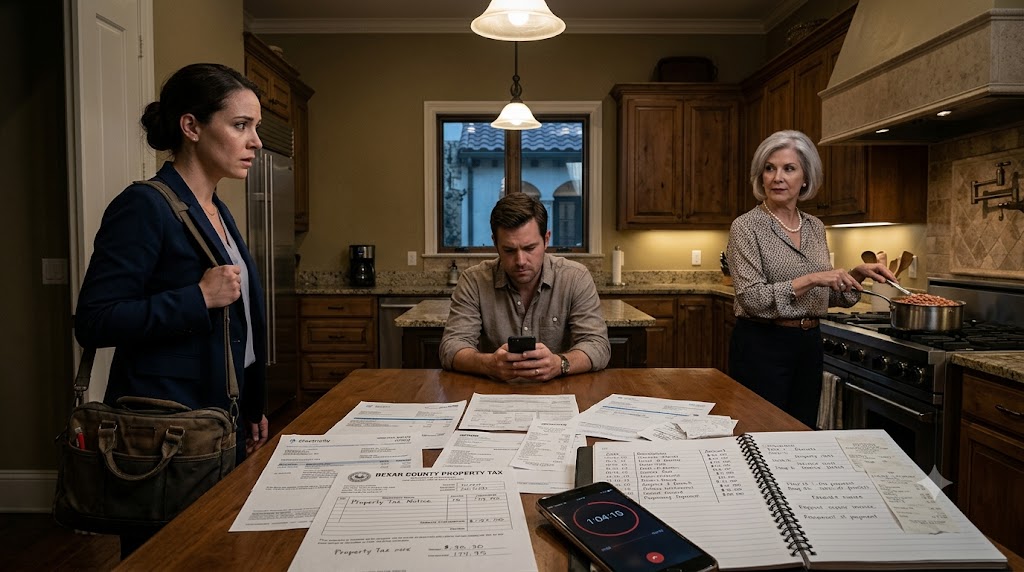
My mother-in-law, Ruth Mercer, uttered those words with absolute calm as she stirred a pot of beans. Her metal spoon dragged heavily across the bottom, filling the kitchen with a harsh, grating scrape.
I froze in the doorway, my heavy work bag still slung over one shoulder. I had been married to Ruth’s son, Colin, for a mere two months, but I was already starting to realize that absolutely nothing spoken inside the Mercer household was ever a coincidence.
Colin sat quietly at the kitchen table, his eyes glued to his phone screen as he scrolled.
He offered no defense for me.
He didn’t bother to ask if my workday had been exhausting.
He didn’t even raise his head to look at me.
“Every single household expense?” I questioned.
Ruth let go of the spoon, leaving it resting upright in the pot.
“The electricity, the water, gas, internet, groceries, yard maintenance, the maid, any repairs, and the property taxes when they come due. All of it. You make a very comfortable salary.”
“And so does Colin.”
“But this is his family’s ancestral home,” she countered. “You moved in here as his wife. A wife shouldn’t expect to reside in someone else’s property without pulling her weight.”
Colin let out an awkward, nervous chuckle.
“Come on, Mom, you’re making it sound much worse than it actually is.”
I shifted my gaze directly toward him.
“Then what exactly is the situation here?”
He finally lifted his eyes from his screen.
“It’s simply a matter of everyone contributing their fair share.”
“Does ‘everyone’ actually mean everyone?”
His focus instantly dropped back to his phone.
That silence was the only response I was going to get.
I silently poured myself a glass of water and walked upstairs without starting a fight.
Standing by the bedroom window, I stared down at the stone courtyard, the vibrant potted flowers, and the modest fountain Ruth fastidiously cleaned every Saturday morning. This grand estate was nestled in one of San Antonio’s historic, wealthy neighborhoods, and Ruth never missed an opportunity to boast about its heritage.
In the beginning, moving in here had seemed like a highly practical decision.
Ruth had been living by herself since her husband’s passing. Colin’s workplace was only a short drive away, and this massive house had more than enough room for all of us. I had agreed to stay here for just a handful of months while Colin and I figured out whether we wanted to rent a local apartment or start house-hunting for a permanent home of our own.
Colin had assured me it was merely a temporary setup.
Ruth had pitched it as a golden opportunity for us to build up our savings.
Foolishly, I had trusted both of them.
I certainly hadn’t come into this marriage empty-handed.
Years before Colin ever entered my life, I had purchased a charming, modest home in a different neighborhood of the city. It featured two bedrooms, a cozy kitchen, and a narrow backyard where I spent weekends tending to herbs in custom wooden planters.
It wasn’t a mansion, but it belonged completely and solely to me.
I had spent almost ten years working diligently as a financial auditor for a major insurance firm. I budgeted strictly, took on every extra project I could get, and funneled nearly every bonus check straight toward paying off the mortgage.
Just six months before our wedding, I proudly submitted the very last payment.
My property was entirely debt-free.
Colin was well aware that I owned it, but I had never discussed its true market value or shared my financial paperwork with Ruth. Whenever the topic arose, I casually referred to it as nothing more than “my little starter home.”
Neither Colin nor his mother had ever probed deeper or asked many questions about it.
Or so I naively thought at the time.
Later that night, as Colin was brushing his teeth, I leaned against the bathroom doorframe.
“Do you actually agree with what your mother said today?”
He kept his eyes locked on his own reflection in the mirror.
“Well, she has a very direct way of putting things.”
“That is not what I asked you, Colin.”
He turned on the faucet and rinsed his brush.
“Tess, you’re living here now. Pitching in for the bills isn’t some crazy request.”
“She didn’t ask me to pitch in. She demanded that I pay all of them.”
“It’ll allow us to set aside more money.”
“Save for what, exactly?”
“For our future together.”
“If that’s the case, why aren’t you paying a single dime toward it?”
Colin let out a heavy sigh.
“I’m tied up with other financial responsibilities.”
“Like what?”
“My car loan, insurance, professional expenses… just standard, everyday things.”
I closely watched his reflection in the glass.
Prior to our wedding, Colin had assured me he was in a great financial position. He was employed in commercial sales and pulled in a highly respectable income. Our agreement was to keep our bank accounts separate for our first year of marriage while contributing 50/50 to any shared expenses.
Yet, since the day we moved into Ruth’s house, Colin hadn’t spent a single dollar on groceries, utility bills, or household maintenance.
I had generously assumed he was funneling all that extra cash into a fund for our future home.
Now, a cold dread told me otherwise.
“We’ve only been married for two months, Tess,” he muttered. “Do we seriously have to start arguing about finances this early?”
That was precisely what terrified me.
We had barely crossed the two-month mark of marriage, and his family was already offloading their entire monthly budget onto me.
The demands slipped in slowly at first.
First, it was just the electric bill.
Soon after, Ruth asked me to cover a massive grocery trip.
A week later, I found the yard maintenance invoice sitting right next to my morning coffee cup.
Shortly after, there was a sudden bill for fixing the hot water heater.
Every single charge was handed over with the casual expectation that I had already agreed to pay it.
“You’re just so wonderfully organized, dear,” Ruth would say with a sweet smile. “You manage finances far better than Colin or I ever could.”
Trusting my professional instincts, I began logging every single transaction in a black notebook:
Date
Description
Amount
Transaction confirmation
On top of that, I snapped a photo of every single invoice and filed it away in a secure, private cloud folder.
In a span of just forty-seven days, I had shelled out over $5,000.
Now, a portion of that sum went toward the groceries I ate and the utilities I consumed. I had no issue with that; paying for my share of daily life was perfectly reasonable.
But nearly half of those funds had been funneled directly into property upgrades, maintenance, and taxes for a house that didn’t have my name anywhere on the deed.
One evening, I walked home from work to find the annual property tax statement laid out neatly right where I usually sat at the dinner table.
A sticky note from Ruth was attached to the front in her neat handwriting:
“Tessa, dear, please make sure this is taken care of by Friday. Thanks!”
That night, I walked down to the kitchen, clutching my black notebook tightly.
Colin and his mother were sitting comfortably, sipping fresh coffee and sharing a plate of pastries.
“I need a direct, honest answer,” I said, keeping my voice steady. “Am I being expected to financially carry this entire household?”
Ruth slowly set her coffee cup back down on her saucer.
“Oh, you aren’t supporting us, Tessa. You are simply contributing.”
I flipped open the black notebook and slid it right onto the table between them.
“Look at this. This is exactly what I have paid out of my own pocket in just forty-seven days.”
Colin squinted at the bottom line, and the color instantly drained from his face.
Ruth, however, didn’t even glance down.
“Are you really keeping tallies on us as if we’re some untrustworthy strangers?” she asked.
“No, I’m keeping records because tracking assets is what I do for a living, and these numbers don’t add up.”
Her lips pressed into a thin, hard line.
“You have a highly lucrative career. Colin is your husband. Why are you acting as though helping your new family is some sort of cruel injustice?”
“Because I am being expected to pay the property taxes and structural repairs on a home that legally belongs only to the two of you.”
“But you are living here.”
“Living here doesn’t mean I am responsible for funding renovations that increase your personal equity.”
Ruth leaned back, folding her arms.
“Well, if you’re going to be so stingy about paying, perhaps you need to remind yourself that this house does not actually belong to you.”
I shifted my eyes to Colin.
He kept his gaze firmly fixed on the wooden tabletop.
“Do you have anything to add to this, Colin?” I asked.
He slowly traced the rim of his coffee mug with his thumb.
“Look, maybe Mom could have worded that a bit better.”
“But do you agree with her core point?”
He offered absolutely nothing but silence.
That profound silence spoke louder and clearer than any words ever could.
The Audit of Truth
The very next day, I spent my lunch hour driving over to the county property records office.
I already had a hunch that Ruth and Colin were the sole owners of the estate, but my mother had drilled a vital piece of advice into my head years ago:
“When your gut tells you something is wrong, suspicion is never enough. You must always confirm the raw facts.”
The official documents revealed that Ruth and Colin indeed held joint ownership of the home.
There was zero mortgage left on it.
No liens of any kind.
Not a single active home loan or line of credit.
The sprawling property was entirely debt-free.
I sat quietly in the driver’s seat of my car for a long time, looking down at the stamped copies resting in my lap.
The Mercers weren’t struggling to pay bills or in danger of losing their home.
They were squeezing me for cash simply because they had earmarked me as an easy mark to exploit.
Later that afternoon, I decided to work from home.
I logged into a lengthy corporate compliance meeting from our upstairs bedroom, setting up my old work phone to record the audio so I could write up perfect notes later. When the meeting wrapped up, I casually set the device down next to my laptop, completely forgetting that the recording app was still active and capturing sound.
I grabbed my purse and personal phone, rushing out of the house to drive back to the office for an unexpected, urgent meeting.
Colin’s car wasn’t parked in the driveway when I departed.
I assumed the bedroom would remain empty and undisturbed.
I could not have been more wrong.
When I got home that evening, I sat down at my laptop, opened up the voice recorder, and got ready to trim and delete the file.
The work meeting itself had only lasted fifty-two minutes.
But the audio file kept playing for almost an hour past that.
I dragged the playback slider forward to see what had been recorded.
Initially, there was nothing but the quiet hum of an empty room.
Then, the distinct creak of the bedroom door opening cut through the static.
Ruth’s voice emerged crisp and clear from my phone’s speaker:
“Where does she hide the closing paperwork for her house?”
The sound of a dresser drawer sliding open echoed.
Colin’s voice responded, “She always kept her important files in that plastic box.”
My heart skipped a beat, and my breath caught in my throat.
I quickly turned the volume all the way up.
“Well, they aren’t in here,” Ruth muttered back.
“She might have put them somewhere else.”
“Did she give you any pushback when you brought up adding your name to her property deed?”
“I haven’t actually asked her directly about it yet.”
“You’ve had more than enough time to handle this, Colin.”
“If I rush her, she’s going to catch on to what we’re doing.”
Ruth let out a heavy, irritated sigh.
“You looked up her property files before you even bought the ring, Colin. You knew that little house was fully paid off. That was the sole reason we agreed you needed to marry her immediately instead of waiting another year.”
The entire bedroom seemed to spin beneath my feet.
Colin didn’t even argue.
Instead, he weakly complained, “I know, Mom, but she’s not an idiot.”
“No, she’s emotional. There is a big difference. Play on that. Tell her it breaks your heart that she doesn’t trust you. Convince her that a real, loving marriage requires sharing everything, including assets.”
“But just putting my name on the deed won’t solve it. She still has to agree to sign the actual loan papers.”
“Then you make sure she signs those as well.”
“And what if she starts asking questions about why we need a home-equity loan?”
“Tell her it’s a down payment for a larger house you two will buy together down the road. Once that cash clears, we can pay off your credit cards and that massive personal loan. Whatever is left over can go straight into renovating this house.”
I clamped a hand over my mouth to stifle a gasp.
Colin had never once mentioned carrying credit card balances, let alone a massive personal loan.
The audio kept rolling.
“What if she finds out the actual amount of my debt?” he asked.
“She has no way of knowing unless you tell her. By the time she’s looking at the final paperwork, you’ll have been married long enough that if she refuses, she’ll look like the selfish one.”
“Well, we’re already married now.”
“Exactly, so stop dragging your feet. Step one was getting her to pay our household expenses—that primes her to carry the financial load. Step two is getting your name on her deed. Step three is signing for that home-equity loan.”
There was a long pause on the tape.
“And if she digs her heels in and says no?”
Ruth’s response was cold and immediate.
“Then you make sure she understands that she has no place in this family unless she starts acting like a proper wife.”
The Paper Trail
I sat there and played the entire recording back-to-back, twice.
The first run-through left me completely numb.
During the second, I focused and took meticulous notes.
Before I even tried to sleep, I backed up the audio file in three separate, encrypted locations.
I also inspected my work bag. The outer compartment was slightly unzipped, which was highly unusual for my organized habits.
Sure enough, my receipt from the county property records office was gone.
Colin already knew I was digging into their financial situation.
First thing the next morning, I contacted Paige Holloway, an experienced family law attorney recommended by a coworker.
Paige listened to every detail as I laid out the forced payments, the hidden debts, the premeditated plot to target my home, and the damning audio.
“Do not sign a single thing they put in front of you—no deeds, no loan applications, no refinancing papers,” Paige warned. “Do not confront them alone. Save every single text message, receipt, bank statement, and audio file. And get your passport, financial documents, and valuables out of that house as soon as you can do so safely.”
“Is there any way they can take my house from me?”
“Absolutely not, unless you willingly sign it away or they commit outright fraud. That’s precisely why they’re putting so much pressure on you to sign.”
“They planned this whole thing before he ever proposed.”
“That is exactly what the evidence indicates.”
“I truly believed he loved me.”
“I am so sorry, Tessa,” Paige said gently. “But right now, your only focus must be self-defense. Does Colin have a key to your house?”
“Yes, he does.”
“The minute you leave, change those locks immediately. Check your credit report right now and put a freeze on your credit.”
The Ultimatum
I drove back to the Mercer residence later that afternoon.
I had no intention of starting a confrontation. My goal was purely logistical: quietly retrieve my passport, birth certificate, Social Security card, my home ownership papers, some jewelry, and enough clothes to get by.
But when I stepped up to the bedroom, I froze.
My black suitcase was wide open, lying in the center of the mattress.
It was already half-packed.
My shirts and pants were folded on one side, and my small jewelry box had been shoved into one of the zippered pockets.
Right next to the suitcase was a neat stack of papers.
Sitting right on top was a legally prepared deed designed to add Colin as a joint owner of my house.
Underneath it lay a pre-filled application for a home-equity line of credit.
Bright yellow sticky tabs marked exactly where my signature was required.
But my birth certificate and passport were nowhere to be seen.
Colin suddenly stepped into the room behind me.
Ruth stood just over his shoulder, her arms tightly crossed.
I looked down at the stack of paperwork.
“What is the meaning of this, Colin?”
Colin’s expression was incredibly strained.
“It’s what we need to sit down and talk about.”
“Where are my passport and my Social Security card?”
“They’re in a safe place.”
“Give them back to me right now.”
“We’ll return them as soon as we finish this conversation.”
I gestured toward the open suitcase.
“Did you seriously pack up my clothes?”
Ruth took a step into the bedroom.
“We felt it would help convey just how serious this situation has become.”
“And what situation is that?”
“Your marriage,” she declared. “Colin has done everything to build a life with you, yet you continue to act as though your personal property is far more valuable than your own husband.”
I brushed my fingertips against the edge of the deed, refusing to pick it up.
“So you expect me to sign over half of my house to him.”
“We expect you to show some actual marital trust.”
“And this loan application?”
Colin took a step toward me.
“Tess, we can use the equity from your place to clear some debts and make a few much-needed updates here. Once that’s done, we’ll be in a perfect position to buy a dream home together.”
“Exactly how much debt do you have, Colin?”
He shifted uncomfortably.
“It’s a manageable amount.”
“Give me a number, Colin. How much?”
“We can discuss the exact figures once you’ve signed the paperwork.”
A dry, humorless laugh escaped my throat.
“So this is my ultimatum? I sign away my home and shoulder your debt, or I get kicked out onto the street?”
“Nobody is kicking you out, Tess,” Colin stammered. “The suitcase is just… Mom thought you might want some space to think if you decided not to work with us on this.”
Ruth’s face was completely devoid of warmth.
“A wife who hoards her assets from her husband has no right to expect things to carry on as normal.”
“I paid off that house before I ever even knew Colin existed.”
“But you are married now.”
“And marriage doesn’t magically turn my life’s work into your personal ATM.”
Colin’s tone grew defensive and sharp.
“No one said it happened automatically! That is exactly why we are sitting here asking you to sign the paperwork.”
I looked him dead in the eye.
“Give me my legal documents, Colin.”
“Not until you sign the deed.”
The words hung in the air, followed by a heavy, suffocating silence.
Colin’s eyes widened slightly as he realized exactly what he had just admitted.
I slowly pulled my personal phone out of my handbag.
“I heard everything you two discussed yesterday afternoon.”
Ruth’s confident posture suddenly faltered.
“What on earth are you talking about?”
I simply tapped the play button.
Her own sharp voice suddenly echoed through the small bedroom:
“You checked the county records before you proposed. You knew the house was paid off. That was the entire reason we agreed you shouldn’t wait another year to marry her.”
Colin looked as if he might pass out.
“Tessa, please, that’s taken entirely out of context—”
I kept the recording playing, drowning out his excuses:
“First she pays the household expenses. Then she adds you to the deed. After that, you both sign for the home-equity loan.”
Ruth suddenly lunged forward, clawing at my hand to grab the phone.
I dodged her easily, stepping back.
“Do not lay a single finger on me.”
“You wiretapped us! That was a private conversation in my home!” she shrieked.
“My work phone was sitting in my bedroom. You are the ones who crept in here to illegally search through my personal belongings.”
“Tess, you’re twisting the truth,” Colin pleaded. “I did love you. I really did.”
“Did?” I echoed.
“I mean… I do love you.”
“You searched my property records before proposing.”
“I was curious.”
“You discussed my house with your mother as a solution to your debts.”
“I was desperate.”
“No,” I said quietly. “You were calculating.”
Colin reached for my arm.
I moved away.
“Do not touch me.”
He stopped.
For the first time since the wedding, he seemed to understand that I was no longer trying to save the marriage.
I was trying to save myself.
I picked up my work bag and car keys.
“My documents will be returned through my attorney.”
“You aren’t leaving like this,” Ruth said.
I walked toward the stairs.
“If you walk out that door,” she called after me, “you will not be welcomed back.”
I stopped at the bottom of the staircase and looked up.
“You did not welcome me into this family. You inspected my finances and decided how much I was worth to you.”
Neither of them answered.
Lock and Key
I left without the suitcase.
I was not going to remain inside the house to collect clothes and jewelry while two angry people blocked access to my identity documents. Those things could be recovered later with witnesses.
I drove straight to my own house.
When I opened the front door, the familiar, comforting scent of clean wood and coffee greeted me.
The gray armchair remained beside the window. My plants leaned gracefully toward the evening light. The dining table I had bought secondhand and spent two weekends sanding stood exactly where I had left it.
In my small kitchen, no one demanded money from me to prove that I deserved a place.
I locked the door behind me.
That night, I slept better than I had since the wedding.
At 7:00 the following morning, I called Paige.
At 8:00, I froze my credit and reviewed my accounts for unfamiliar activity.
At 9:00, a locksmith arrived and changed every exterior lock.
At 11:00, I requested new certified copies of my property documents.
At noon, I canceled the supplementary credit card I had given Colin for emergencies.
At 2:00, Paige sent Colin a formal demand for the immediate return of my identity documents and personal property.
At 4:00, Colin and Ruth arrived at my house.
My video doorbell captured them walking up the path.
Colin held a manila envelope. Ruth carried the deed and loan papers.
I spoke through the locked door.
“Leave my documents on the porch.”
“We need to speak face-to-face,” Colin replied.
“No.”
“I brought everything.”
“Then leave it there.”
Ruth stepped toward the camera.
“This has gone far enough. Open the door and behave like an adult.”
I did not answer.
Colin held up the envelope.
“You can have these as soon as you let us inside and agree to discuss the house.”
The doorbell camera recorded every word.
I called the police.
When the officers arrived, Colin claimed he had only been protecting my documents because I was upset.
One officer asked why he had refused to leave them at the door.
Colin had no convincing answer.
He finally surrendered the envelope.
I checked the contents in front of the officers. My passport, Social Security card, birth certificate, closing documents, and property records were all inside.
Ruth repeatedly called the situation a family misunderstanding.
The officers advised them to leave my property immediately.
The next morning, I filed for divorce.
Several days later, Paige arranged for me to return to the Mercer house with a neutral witness and a police officer present. I collected my suitcase, clothes, jewelry, work equipment, and remaining personal belongings.
Ruth stood in the kitchen without speaking.
The metal spoon rested inside a pot on the stove.
I heard it scrape the bottom once as I walked out.
It was the last time I ever heard that sound.
The Paper Trail Unfolds
As the divorce proceeded, the true extent of Colin’s deception became clear.
He had four credit cards near their limits, a large personal loan Ruth had guaranteed, and overdue accounts already in collection.
His total unsecured debt was far greater than I had ever imagined.
The Mercer house was valuable and debt-free, but Ruth refused to borrow against it. She feared losing the property her husband had left behind.
Instead, they had chosen my house as their target.
Their plan was to pressure me into adding Colin to the deed. Once he became a co-owner, they intended to persuade or guilt me into signing a home-equity loan application with him.
The loan would have been secured by my debt-free property.
The money would have paid Colin’s debts first. Anything left would have been used to renovate Ruth’s house.
The most painful evidence appeared during the exchange of financial records and communications.
Several old messages between Colin and Ruth had been preserved in his account.
They were dated six weeks before he proposed.
In the first message, Colin had sent his mother a screenshot from the county property database:
“Tessa owns the house outright. No mortgage.”
Ruth replied:
“Then do not wait too long. Once you are married, it will be easier to convince her that everything should be shared.”
Another message followed three days before Colin proposed:
“What if she wants a prenuptial agreement?” he had asked.
Ruth answered:
“Act offended. Tell her asking for one means she expects the marriage to fail.”
I read the messages in Paige’s office.
For several moments, I could not speak.
The proposal I had remembered as nervous and romantic had not been spontaneous at all.
Colin had already researched my property.
He had already discussed how to gain access to it.
He had not married me and later become desperate.
My financial security had been part of the attraction from the very beginning.
Colin continued insisting that the messages looked worse than they were.
“I loved you,” he told me during a settlement meeting. “The money was only part of the pressure I was under.”
I looked at him across the table.
“You researched my house before choosing the ring.”
“I wanted to understand what we would have together.”
“You mean what you could take.”
“I made mistakes.”
“A mistake is forgetting an anniversary. A plan that begins before the proposal and continues after the wedding is not a mistake.”
Ruth attempted to describe herself as a protective mother.
“I only wanted my son and his wife to build a stable life.”
Paige placed my records on the table:
The transfer receipts.
My black notebook.
The property-tax bill.
The repair invoices.
The prepared deed.
The loan application.
The doorstep video.
The communications proving Colin had investigated my property before our engagement.
The recording was preserved and evaluated by the attorneys according to the applicable rules. It was not the only evidence, and my case did not depend entirely upon it.
The documentary record told the exact same story.
I had not been asked to build a future with Colin.
I had been asked to finance the future he and Ruth wanted for themselves.
A New Shade of Green
The divorce was finalized six months later.
I did not recover the money I had spent on groceries or the ordinary utilities I had used while living in the Mercer house.
However, the final settlement reimbursed me for part of the property taxes and major improvements I had paid on a house owned by Colin and Ruth.
More importantly, my house remained entirely mine.
So did my savings, retirement accounts, and everything I had owned before the marriage.
Colin remained responsible for his concealed debts.
Ruth had to decide whether to help him using her own property instead of mine.
On the afternoon the divorce became final, I returned home and opened every window.
I moved the gray armchair closer to the light and played music while covering the living-room floor with old sheets.
Then I painted one wall olive green.
Not because the color was fashionable.
Not because an interior designer recommended it.
Not because someone else approved.
I painted it olive green because I liked it.
Several months later, a woman named Naomi moved into the house next door. I saw her carrying boxes from a rented truck and brought her a pitcher of lemonade.
“Thank you,” she said. “I recently left my husband. I’m still getting used to doing everything alone.”
I looked back at my own house, glowing warmly in the late-afternoon light.
“Sometimes doing everything alone is easier than living with people who make you pay for the privilege of belonging.”
Naomi nodded as though she understood.
That evening, I cooked soup in my own kitchen.
The spoon touched the bottom of the pot once, softly.
There was no angry scraping.
No demand waiting beside my plate.
No husband sitting silently while someone explained what I owed.
I remembered something my mother had told me years earlier.
“Write everything down. Not because everyone is dishonest, but because the truth needs something solid to stand on.”
For a long time, I had believed my best investment was the house I had purchased through years of work and sacrifice.
Eventually, I understood that it was something else.
My best investment had been learning to trust the moment when kindness began to feel like calculation.
Colin and Ruth had opened their door not because they wanted to welcome me, but because they wanted to determine how much they could extract from me.
They expected me to pay their expenses.
They expected me to sign away part of my home.
They expected me to carry Colin’s debts.
Most of all, they expected me to remain silent.
On the 53rd day of my marriage, I refused.
That single word protected everything I had spent years building.
I said no.