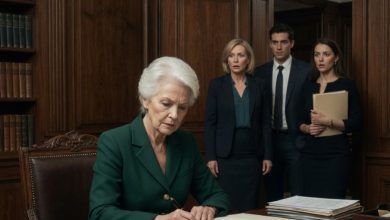
My son was bringing me to France to spend my retirement there, and at the airport, my 8-year-old granddaughter secretly placed a piece of paper in my hand: “Run.” I faked a stomach pain and turned around to get out of the airport.
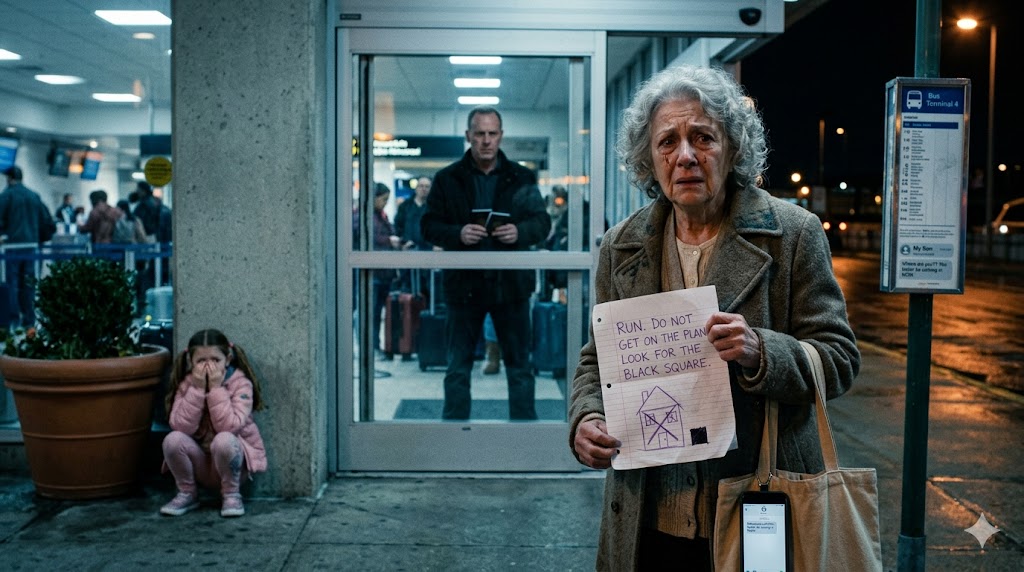
“Stop playing games.”
I read the text twice.
Then, I deleted it from my screen without writing back.
It wasn’t because I wasn’t scared.
I was actually so terrified that my legs were shaking underneath the linen pants Matthew had picked out for the trip—as if even the clothes on my body had to obey him.
I walked toward the airport taxi stand, clutching my purse tightly against my chest.
Behind me, the airport kept breathing with its loud mix of rolling suitcases, announcements, and goodbyes. But I felt like every loudspeaker was calling out my name:
“Helena Barbosa, go back to your son.”
Nobody was actually saying that, of course.
But the voice inside my head was.
My phone started vibrating over and over.
Matthew was calling.
Once.
Twice.
Three times.
I didn’t answer.
Instead, I got into the first taxi I could find.
“Where to, ma’am?” the driver asked.
I opened my mouth, but no words came out.
I didn’t know where to go.
My house in Brooklyn wasn’t mine anymore, at least according to Matthew.
He had told me it was “in the process of being sold” and that I needed to go to France while he finalized all the paperwork.
But Lily’s note had said:
“Look for the black square.”
The house.
The crossed-out window.
The dark square.
“Brooklyn,” I told the driver. “Park Slope, near Seventh Avenue.”
The driver glanced at me in the rearview mirror.
“It looks like it’s going to rain.”
I looked up at the gray New York sky.
“Then please drive fast.”
On the way there, Matthew kept sending messages.
“Mom, this is ridiculous.”
“I am going to call airport security.”
“Lily is crying because of you.”
That last one almost made me turn the car around.
Lily.
My baby girl.
My eight-year-old granddaughter, with her messy braids and colored pencils, had risked everything to slip that note into my hand.
I couldn’t fail her now.
I called my lifelong neighbor, Nancy, who lived right next door.
She answered, sounding like I had just woken her up from a nap.
“Helena? Weren’t you on your way to Paris?”
“Nancy, I need you to look at my house from your window right now. Is anyone there?”
Silence stretched over the line.
Then I heard the sound of window blinds moving.
“There’s a black car parked outside,” Nancy whispered. “And two men are at your gate.”
The back of my neck went ice-cold.
“Is it Matthew?”
“No, it’s not him. They are carrying boxes out of the house.”
I closed my eyes.
The house in Brooklyn.
The home where Anthony and I had lived for thirty-seven years.
The house where Matthew learned to ride his bicycle in the hallway, where Lily drew her very first picture on my kitchen wall, and where I kept my husband’s old love letters in a cookie tin.
“Nancy, call your nephew.”
“The one who works for the police?”
“No. The lawyer.”
“Helena, what on earth did you do?”
I looked down at Lily’s note in my hand.
“I think I finally woke up.”
I didn’t go straight to the house.
Halfway there, I asked the taxi driver to drop me off in front of an old diner in Brooklyn—one of those classic places that still serves hot buttered toast and coffee at any hour of the day.
I went inside, ordered a glass of water, and called someone I hadn’t spoken to in years: Sarah Jenkins, my husband’s lawyer from before he passed away.
Sarah answered, her voice dry and professional, just like always.
“Mrs. Barbosa.”
“My son is trying to take me to France against my will,” I said plainly.
There was no shock in her voice.
Only sharp attention.
“Where are you right now?”
“In a diner. Park Slope.”
“Do not go to your house alone,” she ordered.
“There are already men there taking out boxes.”
Sarah took a deep, heavy breath.
“Did you sign a power of attorney?”
I thought back to those recent afternoons.
I pictured Matthew sitting with me at the kitchen table, sliding sheets of paper in front of me.
“Mom, it’s just for the bank.”
“Mom, it’s just to make the taxes easier.”
“Mom, don’t bother reading everything, you’ll just get tired.”
“I signed some things,” I admitted.
“In front of a notary?”
“Yes.”
“Did you understand what you were signing?”
A hot, painful wave of shame washed over me.
For years, I was the one who managed our household expenses. I took care of Anthony when he was sick. I paid for groceries, schools, doctors, and bills. Now, I had to admit that my own son had tricked me into signing documents I didn’t understand.
“No,” I whispered.
Sarah didn’t lecture or scold me.
That kindness saved me from breaking down.
“I’m on my way to you,” she said. “Do not move. And turn off your phone’s location.”
I stared at the screen. I didn’t even know how to do that.
A young girl sitting at the next table had overheard part of my conversation and walked over.
“Can I help?” she asked gently.
She looked to be about twenty years old, with blue-dyed tips in her hair and a small nose piercing.
“My son is tracking me,” I said, feeling completely ridiculous.
But she didn’t laugh.
She took my phone, opened up the settings, and disabled the location sharing, tracking apps, and permissions.
“There you go, ma’am,” she said, handing it back. “And you should delete this, too.”
She pointed to an app with an innocent-sounding name: Family Care.
I hadn’t installed it.
Matthew had.
“Don’t answer his calls,” the girl advised. “Only text back. That way, everything is in writing and you have proof.”
I thanked her, my voice cracking with emotion.
She squeezed my hand warmly.
“My grandmother went through something very similar. Do not go back to him alone.”
Sarah arrived twenty minutes later, carrying a briefcase, wearing dark sunglasses, and looking ready for a fight.
She listened to my story.
She read Lily’s crumpled note.
She looked through Matthew’s angry messages.
Then she stood up. “We are going to enter your house, and we are bringing witnesses.”
“What if those men are dangerous?” I asked.
“That’s exactly why we aren’t going alone.”
Nancy’s lawyer nephew arrived a few moments later. His name was Paul. He was a retired public defender who walked slowly with a cane, but he had the sharp, piercing eyes of a hawk.
“The Elder Abuse Prevention Act is a powerful tool when people actually use it,” Paul said, looking at me intently. “Your son cannot force you out of the country or empty your home if you don’t want him to.”
“But I signed those papers.”
“Signatures obtained through fraud and deception can be fought in court.”
We drove over in two separate cars.
Nancy was waiting for us at her front gate, still wearing rollers in her hair and clutching a rosary.
When she saw me, she hugged me so tightly I could barely breathe.
“I knew that boy was acting strange lately,” she muttered.
The front gate to my house was wide open.
Two men were actively loading cardboard boxes into the back of a moving van.
One of them tried to step in our way, claiming it was an authorized move. But Sarah pulled out her credentials and spoke with a calm, freezing authority that cut right through him.
“Nobody touches another thing until you identify yourselves and show us a legal order or a signed contract.”
The man hesitated, looking uneasy.
Paul already had his phone out, recording everything.
I stepped past them and walked inside.
The house smelled of disturbed dust, a strange perfume I didn’t recognize, and deep betrayal.
The living room was completely ruined.
Anthony’s old books were thrown carelessly into boxes.
The paintings had been ripped off the walls.
My sewing machine was wrapped up tightly in clear plastic.
In the dining room, sitting right on the table, was a pile of documents with my name on them, resting next to a thick blue folder.
Sarah opened it up.
Her face turned instantly to stone.
“Helena, this is a broad, unlimited power of attorney. It gives him control over asset management, sales, banking, medical decisions, and authorization of residence abroad.”
“Residence?” I asked, my voice trembling.
“Yes. This trip to France wasn’t a vacation.”
I had to sit down because the floor suddenly felt like it was spinning beneath me.
“What was he planning to do with me?”
Paul answered with a quiet sadness:
“Send you far away, ma’am. Somewhere you couldn’t easily come back from.”
Then, I remembered the drawing.
The black square.
I stood up and walked down the hallway.
The crossed-out window Lily always drew belonged to my old sewing room at the back of the house, right next to the laundry area.
We had used that room to store tools after Anthony died.
Matthew had always wanted to tear it down to “modernize” the space.
I walked in.
The room was filled with open boxes, old rags, a ladder, and paint cans.
I searched everywhere for a black square.
On the walls.
On the floor.
On the door frames.
Nothing.
Suddenly, my phone buzzed in my hand. It was another message from Matthew:
“I know you are at the house. Don’t make this end badly.”
I showed the screen to Sarah.
“Keep it,” she said firmly. “Every single threat helps our case.”
I looked around the messy room one more time.
And then, I finally spotted it.
Right against the baseboard, hidden behind an old box of spare tiles, there was a small black metal plate.
It wasn’t a decoration.
It was a small metal cover, painted to blend into the bottom of the wall.
I got down on my knees.
I pressed against it, but it wouldn’t budge.
Paul walked into the room behind me. “That looks like a built-in wall safe.”
“Anthony never told me about this…” I started to say.
But then I stopped myself.
He had told me.
Years ago, when his memory first started slipping and he would forget small things, Anthony had taken me into this exact room. He had looked at me seriously and said:
“If one day Matthew changes too much, remember the black square.”
At the time, I thought he was talking about an old painting I could never find.
A painting.
A square.
A black canvas.
But my husband hadn’t been confused at all. He had left me a lifeline, and my granddaughter had rescued it with her drawings.
Sarah searched the nearby shelves and found a key taped underneath a ledge with old, yellowed tape.
She handed it to me. I turned it in the lock, and the plate opened with a sharp click.
Inside was a heavy metal box.
And inside that box lay my entire life, hidden away from my own son.
There were old letters from Anthony, official copies of property deeds, a copy of his true will, a digital thumb drive, bank statements, and a handwritten note in his shaky, familiar script:
“Helena, if you are reading this, it means Matthew has already tried to do to you what he wanted to do to me. Do not sign anything. The house must never be sold. There is an account in your name that he cannot touch. And there is proof.”
I couldn’t read any further.
I covered my mouth and broke down sobbing, sitting right there on the dusty floor of the sewing room, while Nancy prayed softly behind me.
Sarah took the thumb drive out of the box.
“We need to see what’s on this right now.”
We plugged it into Anthony’s old computer on the desk. The very first folder that popped up was labeled in all capital letters:
“MATTHEW.”
Inside were audio recordings.
In the first file, Matthew’s voice came through the speakers clear as day. He was talking to someone on the phone out on the porch:
“As soon as Mom signs, I’m sending her to Lyon with Paula. Nobody is going to bring her back from over there. Then we sell the Brooklyn house, pocket the money, and close the matter for good.”
Paula.
My daughter-in-law.
Lily’s mother.
I had spent months believing she was living happily in France for a new job, because that was the story Matthew had fed me. He told me Lily was only staying with him “temporarily” in New York because Paula had to travel so much.
The next recording made my blood run cold.
It was Paula’s voice, sobbing hysterically.
“Matthew, please, you can’t just take my daughter away from me.”
And Matthew replied, cold and unbothered:
“Then sign the custody agreement and stop causing trouble. My mother is coming over, and she’s going to convince Lily that everything is fine. If you try to fight me, I’ll tell the court you’re mentally unstable.”
Paula hadn’t left us by choice.
He had cut her off and forced her away.
Just like he was trying to do to me.
“Lily…” I whispered, my heart breaking.
At that exact moment, a loud, heavy bang echoed from the front door.
Matthew burst into the house like a hurricane.
But he wasn’t alone.
He had brought two men with him: a man dressed in a sharp business suit, and another man in a white shirt carrying a professional medical briefcase.
“Mom,” Matthew said, trying hard to force a warm smile when he noticed Sarah and Paul standing there. “I am so glad you’re here. I was incredibly worried about you.”
“Do not come any closer to me,” I said.
He stopped dead in his tracks.
I had never spoken to him in that tone of voice in his entire life.
“You’re clearly upset, Mom,” he said, his voice dropping into a smooth, patronizing tone. “That’s exactly why I brought Dr. Esteves with me. We just want to give you a quick checkup.”
Sarah stepped firmly between us, blocking him from me.
“Mrs. Barbosa does not authorize any private medical evaluations.”
Matthew’s jaw clenched tight.
“I am her son.”
“And I am her legal counsel.”
The man in the suit stepped forward. “There are legally signed documents giving him authorization.”
Paul held up the heavy metal box we had just uncovered.
“And we have better documents.”
Matthew’s eyes landed on the box.
Instantly, his entire expression changed.
It was a subtle shift, but it was enough to show his panic.
“Where did you find that?”
“In the one place your father knew you would never bother to look,” I said, looking him dead in the eye. “A part of this house that didn’t bring in any money.”
He stepped forward aggressively.
“Mom, give me that box right now.”
“No.”
“You have no idea what you’re doing.”
“For the first time in months, Matthew, I know exactly what I’m doing.”
The doctor tried to step in, using a soft, comforting voice meant to soothe a child.
“Mrs. Barbosa, severe anxiety can cause a lot of mental confusion. Your son is only looking out for your safety.”
I turned my gaze to the doctor.
“Doctor, if you are so deeply concerned about my safety, why don’t you ask him why he was taking me to a foreign country with papers I couldn’t read and a tracking app hidden on my phone?”
The doctor immediately fell silent and stepped back.
Matthew completely lost his temper.
“All of this was for your own good!” he screamed.
Nancy let out a loud, mocking laugh from the doorway.
“Oh, of course! It’s always for the good of the old woman—and the house that’s worth millions of dollars.”
Sarah had already called the authorities.
When the police officers arrived, Matthew quickly put his polite mask back on.
He started talking smoothly about my old age. About my grief over losing Anthony. About my supposed “mental decline” and how often I forgot things.
For a terrifying second, I was afraid the officers would believe him.
I felt like that weak, doubtful mother again, wondering if I really was losing my mind.
But then, Lily appeared at the front door.
I don’t even know how she managed to get there so fast.
Paula had brought her.
My daughter-in-law looked much thinner than before, with deep dark circles under her eyes, clutching a thick folder tightly against her chest.
Lily took one look at me and ran straight into the room.
“Grandma!”
I caught her and held her so tightly it felt like I was tucking her right back inside my ribs.
Matthew turned completely pale.
“Paula? What are you doing here?”
She held up the folder in her hands, her voice shaking but furious.
“The exact same thing as your mother, Matthew. I stopped obeying you.”
Lily pointed a small finger at her father.
“He told me Grandma was going to a house where they wouldn’t let her make phone calls. I heard him say it.”
Matthew snapped, “Lily, shut up!”
The girl shrank back, hiding behind my legs, but she kept speaking.
“And he said if Mom ever came back to New York, he was going to tell everyone she was crazy.”
Paula marched over and handed her folder straight to Sarah.
Inside was an undeniable trail of evidence.
Saved text messages. Secret audio recordings. Written threats. Unauthorized bank transfers. A hidden legal draft for the sale of my house, and requests for forced medical evaluations for both me and Paula.
Two different generations of women, both targeted with the exact same weapon:
Being labeled as unstable.
The police didn’t put handcuffs on Matthew that afternoon.
Real life doesn’t always move as fast as our pain does.
But an official police report was filed. A formal record was made. Every single part of the moving process was immediately frozen.
Sarah filed urgent court orders to protect my property and my legal right to make my own decisions. The doctor and Matthew’s lawyer were forced to identify themselves to the police, and the moving men had to leave every single box right where it lay.
Matthew was forced to walk out of my house without taking so much as a single book.
Before he crossed the gate, he turned around and glared at me.
“You are going to regret this, Mom.”
I held Lily’s small hand firmly in mine.
“No, Matthew. I only regret taking so long to see the truth.”
The months that followed were incredibly exhausting.
The fraudulent power of attorney I had signed was heavily contested in court. The notary office was forced to answer for why they allowed me to sign documents without proper explanations.
The hidden bank account Anthony had left behind became my saving grace, allowing me to pay for excellent lawyers, independent doctors, and necessary house repairs. Every single transfer Matthew had made using his doubtful authorizations was put under investigation.
Paula started her own legal battle to regain full custody of Lily.
Through it all, Matthew told everyone who would listen that we had betrayed him.
That was his favorite word. Betrayal. As if the truth itself is a betrayal the moment it stops serving his interests.
He tried to come to my house once, crying and begging for forgiveness. I refused to let him in.
He sent expensive flowers. I sent them right back.
He even sent a local pastor we had known for years to talk to me about Christian forgiveness.
I looked at the pastor and said:
“To forgive someone does not mean handing the keys to your house back over to them.”
The pastor never came back.
Lily stayed with Paula and me for a few weeks until a judge established clear, legal safety measures.
Sometimes at night, she would wake up from a nightmare and crawl into my bed.
“Were you really going to leave forever, Grandma?”
“No, my love. Never.”
“But he told me that over there, nobody would ever believe anything you said.”
I stroked her hair gently in the dark.
“That’s exactly why you gave me that piece of paper, sweetie.”
“I was so scared.”
“I was too.”
“Did I do a bad thing?”
I pulled her closer and kissed her forehead.
“You saved my life.”
She cried silently against my shoulder. She was only eight years old, but she already understood that adults could use the word “love” to disguise a trap.
That was what hurt me the most out of this entire ordeal.
Not the stolen money. Not the house. Not the legal papers.
It was the fact that my little granddaughter had to act as an alarm system because the adults around her were asleep to the danger.
Paula and I spent hours talking at the kitchen table.
At first, it was incredibly awkward. I felt immense guilt because I had failed her, too. I had believed Matthew when he told me she was a “difficult” and “unstable” woman. I thought she was just exaggerating her problems. I had naively believed that a mother wouldn’t leave her daughter behind unless she had done something wrong.
The shame burned deep in my chest.
“Please forgive me,” I told her one afternoon while we were brewing coffee.
Paula looked down at her cup, pausing before she answered.
“I understand, Helena. I spent a long time thinking you were on his side, too.”
“I was on my son’s side,” I said softly. “And I didn’t bother to look at who he was stepping on to get what he wanted.”
She sighed. “That’s his biggest strength. He knows exactly how to use the fact that people love him.”
And it was true.
Matthew used love like a master key to unlock whatever he wanted.
He used it on me, on Paula, on Lily, and even on the memory of his own father.
The house in Brooklyn was never sold.
Instead, we repainted the whole place. Not because we wanted to erase our history, but because we wanted to reclaim it.
The sewing room became my sanctuary again.
I cleared out all of Matthew’s boxes, scrubbed the floors, and set my sewing machine right back in front of the window.
On the wall, I left the black metal plate completely visible, refusing to hide it away ever again. Lily even pasted bright purple paper stars all around the edges.
“So it doesn’t look like a scary place anymore,” she explained happily.
I kept the house, but I took legal steps that Matthew never could have anticipated.
With Sarah’s help, I placed the entire property under ironclad legal protection. I signed a new will, created a life estate, set up independent medical directives, and appointed external trustees. I added a very strict clause: no family member could ever make a decision for me without a full judicial review and my own independent lawyer present.
Sarah smiled broadly the day I finalized the paperwork.
“You’re entirely safe now, Mrs. Barbosa. Your will has a permanent lock on it.”
Matthew faced extensive legal proceedings.
He didn’t go to prison right away, as some charges remained trapped in civil court while others were processed through criminal investigations. But he lost everything he was fighting for. He lost access to my bank accounts, he lost his claim to the house, and he lost the power to control Lily’s life.
Paula regained her independence and stability.
And I finally regained my right to say the word “no” without feeling the need to apologize for it.
A year later, Matthew sent me a long letter.
He wrote that he was deep in debt. He claimed he had been under too much pressure at work. He swore he never actually wanted to hurt me, and insisted that moving to France really would have been “the best thing” for my old age.
He never answered the single question I sent back to him through my lawyer:
“Why did my own granddaughter have to warn me to run?”
Because there is no good answer to that question.
Today, I am still living happily in Brooklyn.
Sometimes I take a quiet walk down to the local street market. I buy fresh pastries, ripe tomatoes, sweet herbs, and bright flowers for the kitchen table.
On Saturdays, I like to sit out in the public square, drinking a warm cup of coffee and watching the world go by. Whenever I do, my mind inevitably drifts back to that chaotic morning at the airport.
I think about my tightly closed fist.
I think about that single word written in purple pencil.
RUN.
Such a tiny word.
A simple instruction from a child.
An open door to freedom.
Lily is ten years old now.
She doesn’t draw those sad, crossed-out windows anymore. Now, she draws houses with tons of open doors, though she always makes sure to include a little black square somewhere on the wall.
“Is that still the secret hiding place?” I asked her one afternoon.
“No,” she said with a bright smile. “Now it’s the emergency button.”
I laughed out loud.
And then, a moment later, I wiped away a tear when she wasn’t looking.
Paula works close by now. She comes over to the house almost every afternoon, and the three of us have dinner together. We make rice, chicken, fresh salad, and warm cornbread whenever I want to spoil them.
The house is filled with beautiful, healthy noise again.
It’s not the tense silence of hidden legal papers, or the hushed whispering of secret phone calls in empty hallways. It’s the comforting sound of clattering dishes, school homework, the television playing in the background, and genuine laughter.
Matthew is not allowed inside.
He can write all the letters he wants. He can request formal court hearings. He can sit in front of as many judges as he can find. But the doors to Park Slope do not open up for his guilt anymore.
That morning at JFK airport, my son told me he was taking me to France to enjoy my retirement.
That was his story.
But the ugly truth was entirely different.
He was trying to strip me away from my home, away from my hard-earned savings, away from my precious memories, and away from my fundamental right to choose my own path. He wanted to turn me into nothing more than an absent signature—a grateful, silent mother tucked away on the other side of an ocean.
But my eight-year-old granddaughter put a scrap of paper in my hand.
“RUN.”
I faked a stomach ache.
I turned my back on that flight.
I went looking for the black square.
And along the way, I found so much more than just a box of hidden documents.
I found my husband’s final act of protection.
I found the immense bravery of a young child.
I found Paula’s undeniable truth.
I saw my son’s real face for the very first time.
And most importantly, I found a version of myself that I thought had been lost to old age long ago: a woman completely capable of standing on her own two feet, closing her fist against injustice, walking right through an automatic exit door, and choosing her own destiny before anyone else could try to file her life away like paperwork.
Sometimes, people ask me if it broke my heart to report my own son to the law.
Of course it did. It hurt deeply. There are some betrayals and pains that you never truly get over. You don’t cure them; you just learn how to carry them with you.
But I know in my heart it would have hurt significantly more to get onto that airplane, look out the window at the clouds, and discover when it was already too late that I wasn’t flying toward a beautiful new life in Paris.
I was flying straight into a forced silence.
That is exactly why I keep Lily’s tiny note safely locked inside a small wooden box on my dresser.
It sits right next to Anthony’s old love letters.
Right next to the key that opens the black square.
Right next to my brand-new legal will.
Every now and then, I open the box, pull out that faded piece of paper, and look at the word written in that shaky, childish handwriting.
RUN.
I don’t read it as a message of fear anymore.
Now, I read it as my true inheritance.
Because that little girl taught me that even a grandmother can be born all over again at an airport exit door—even with a broken heart, a left-behind suitcase, and only one absolute certainty left in her mind:
If someone tries to take you far away from everything you know under the guise of “taking care of you,” but refuses to let you make your own choices… it isn’t care at all.
It is a kidnapping with a one-way ticket.
And I, Helena Barbosa, was simply not born to disappear for the sake of anyone’s version of love.