My eight-year-old son lay on the floor, gasping for air,
Part 1: The Breaking Point
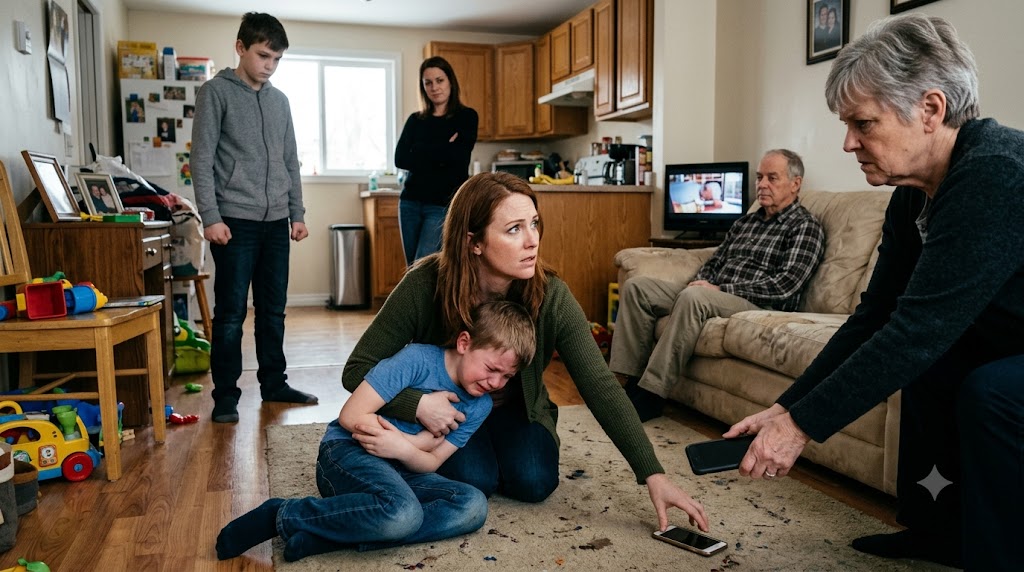
My eight-year-old boy was curled up on the living room rug, fighting for every single breath.
At first, I honestly thought he’d just had the wind knocked out of him. Kids take tumbles all the time—tumbling off bicycles, slipping out of backyard trees, or tripping over their own untied laces. But this was entirely different. His tiny hands were pressed hard against his ribs, his face completely drained of color and tight with agony. Every gasp he took was shallow, jagged, and terrified.
“Mom… it hurts so bad,” he whimpered.
I dropped straight to my knees beside him. “Where, baby? Show me.”
He pointed toward his side. The second my fingertips brushed his shirt, a sharp, agonizing cry ripped from his throat, sending a sickening chill straight to my stomach.
Standing across the room was the one who had done this—my twelve-year-old nephew, Ryan. He was tall for his age, looming in the corner with his fists still tightly balled, as if the violence hadn’t quite left his system yet.
“What did you do?” I demanded, my voice shaking.
Silence. Nobody said a word.
Ryan shifted his gaze, looking away. My sister, Carla, just leaned casually against the kitchen counter with her arms crossed, completely unbothered. On the couch, my parents sat like indifferent spectators who had accidentally tuned into the wrong television channel.
“He just gave him a little push,” Carla muttered finally, her tone so incredibly casual it made my ears ring. “Kids get rough. It’s no big deal.”
Tears rolled silently down my son’s pale cheeks.
With trembling hands, I pulled out my phone and punched in 911.
But before the call could even connect, my mother lunged forward. She snatched the phone right out of my hand.
“Don’t you dare do that,” she hissed.
I stared at her, utterly paralyzed with shock.
“Mom, look at him! He can’t breathe!”
“Boys fight,” she said, her voice cold and sharp. “You are not going to ruin your nephew’s entire future over some silly playground scuffle.”
My father didn’t even bother to look up at his crying grandson.
“You’re making a mountain out of a molehill,” he grumbled. “He’ll be perfectly fine in a day or two.”
I looked over at Carla.
She was smirking.
There was no remorse in her eyes. No panic. Just a cruel, smug smile.
In that very moment, something deep inside me shifted. It wasn’t a loud, dramatic explosion, but a quiet, rock-solid realization.
My son gasped again, a weak, pathetic whimper escaping his lips.
I stood up slowly, finding my footing.
“Give me my phone,” I said, keeping my voice level.
“Absolutely not,” my mother snapped, clutching it even tighter against her chest. “You are not bringing the police into family business.”
The entire room fell dead silent.
None of them had any idea that their cruel indifference had just pushed me past the point of no return.
So, instead of wasting another breath arguing, I did the one thing they never expected.
I grabbed my car keys off the counter, carefully scooped my hurting boy into my arms, and walked straight out the door.
Part 2: The Choice to Fight
The moment I stepped out onto the porch, the cool night air hit my face, but it did nothing to soothe the burning rage inside me.
My son buried his tear-stained face into my shoulder, trying his best not to sob because every single movement rattled his ribs.
“It’s going to be okay,” I murmured, though I wasn’t sure if I was saying it for him or for myself. “I’ve got you. You’re safe.”
Behind me, the front door slammed open, cutting through the quiet evening.
“Get back inside this house right now!” my mother yelled.
I didn’t even pause. I kept walking toward my car.
“You are not taking him to a hospital!” she screamed.
I kept moving.
“Are you listening to me?” she barked.
My father stepped out onto the porch behind her, his face twisted with annoyance rather than any actual concern for his grandson.
“You are making an absolute fool of yourself,” he called out.
Still, I didn’t stop.
Carla sauntered out next, leaning against the railing.
“You’ve always lived for the drama,” she shouted after me. “Ryan barely even touched him. Stop being pathetic.”
I looked down at the fragile boy in my arms.
His lips were starting to take on a faint, terrifying shade of blue.
That was the only confirmation I needed.
I laid him into the passenger seat, buckling him in with agonizing care. Every tiny adjustment made him wince and gasp.
“I’m so sorry, baby,” I whispered softly.
“For what, Mom?” he breathed.
“For bringing you to this house.”
His small, fragile hand reached across the console and gently squeezed mine.
“I didn’t do anything wrong, did I?”
“No, sweetheart. You did absolutely nothing wrong.”
Those words felt like a physical blow to my chest.
The local emergency room was only a twelve-minute drive.
But that night, it felt like an eternity.
Every single red light felt like a personal roadblock.
Every time he struggled to catch his breath, my grip on the steering wheel tightened until my knuckles turned stark white.
When we finally pulled up to the ER entrance, the triage nurses rushed toward us the second they saw the way my son was clutching his chest.
They took one look at his pale face and leaped into action.
A wheelchair was brought out instantly.
“Can you tell me what happened?” a nurse asked, her pen poised over her clipboard as she wheeled him through the double doors.
“My twelve-year-old nephew attacked him.”
Her hand paused for a fraction of a second.
“How old is your little boy?”
“He’s only eight.”
“And the nephew is twelve?”
“Yes.”
Her professional gaze softened into serious concern. She nodded firmly.
“We’re bringing him straight to the back.”
The hour that followed was a dizzying blur of sterile lights and sterile smells.
Doctors in scrubs.
Rapid X-rays.
Detailed CT scans.
Endless intake questions.
Stacks of paperwork.
I forced myself to answer every question clearly, desperately fighting back the terrifying thoughts creeping into my mind.
Finally, the emergency room physician stepped into our curtained cubicle.
He pulled the curtain shut behind him, his face grave.
“I have the imaging results.”
I stood up instantly, my heart hammering against my ribs.
“Your son has sustained a fractured rib.”
My knees went weak, and I had to grab the edge of the bed to stay upright.
“The bone fracture itself will heal with time and rest,” the doctor continued.
I let out a ragged sigh of relief.
“However…”
That single word made the air in the room turn to ice.
“…the jagged edge of the broken rib bruised his lung.”
My heart stopped.
“He is suffering from a pulmonary contusion.”
I stared at him, my mind spinning. “I… I don’t understand. What does that mean?”
“It means there is localized bleeding and fluid buildup in his lung tissue from the blunt force. He is stable for now, but we are admitting him to the pediatric ward overnight for close monitoring. I have to be honest with you—if you had waited a few more hours to bring him in…”
He paused, letting the weight of his words sink in.
“…this could have easily turned into a life-threatening emergency.”
I couldn’t even find my voice.
The doctor looked at me with deep, validating kindness.
“You brought him in at the exact right moment. You did the right thing.”
And just like that, the dam broke. For the first time since I walked out of my parents’ house, I let the tears fall.
I didn’t sob. I didn’t make a sound.
I just stood there as silent, heavy tears streamed down my face.
Around midnight, a soft, polite knock sounded on the hospital door.
“Excuse me, ma’am?”
I quickly wiped my eyes and cleared my throat. “Yes? Come in.”
A police officer stepped into the dim light. “I’m Officer Daniels.”
He pulled up a plastic chair and sat down.
“The hospital is legally obligated to contact law enforcement whenever a minor is admitted with injuries that point to physical assault.”
I nodded slowly. “I expected as much.”
“I need you to tell me exactly what happened tonight.”
For the next forty minutes, I poured everything out.
I didn’t hold back a single detail.
The sudden escalation.
Ryan’s violent outburst.
My mother physically snatching my phone to block a 911 call.
My father dismissing my injured child as an overreaction.
Carla mocking my panic.
Officer Daniels wrote diligently in his notepad.
Then, he looked up and asked quietly, “Did any of the adults present try to step in and stop your nephew?”
I pictured the scene again.
Ryan slamming my boy to the hardwood floor.
The heavy, deliberate kicks to his tiny ribs.
No one moved an inch.
“No,” I whispered. “Nobody.”
“Did anyone check to see if your son was alright?”
“No.”
“Did anyone actively try to prevent you from getting him medical help?”
“Yes. My mother physically took my phone out of my hands.”
The officer stopped writing and stared at me. “She took your phone?”
“Yes.”
“Explicitly to prevent you from calling emergency services?”
“Yes.”
He was silent for a long moment, processing the gravity of the situation. Then, he closed his notebook with a firm snap.
“Thank you for being so thorough and honest.”
He stood up, adjusting his belt. “I’ll be in touch with you soon.”
The next morning, the screen of my phone was a relentless wall of notifications.
Thirty-two missed calls.
Twenty-one text messages.
But not a single one of those notifications was from someone asking if my little boy was going to be okay.
Every single message was a furious demand, wanting to know why on earth I had spoken to the police.
My sister Carla’s messages were the most vicious:
Are you happy now?
Ryan was just playing around.
You’ve officially ruined this family.
My mother’s texts were even more manipulative:
Blood is supposed to protect blood.
Family matters are solved within the family.
Call the police back right now and tell them you made a mistake.
My father sent a single, chilling line:
What you did is absolutely unforgivable.
Not a single text asked, “How is he doing?” or “Is he okay?”
I looked over at my son, who was sleeping peacefully in his hospital bed, his small chest rising and falling in a steady, comfortable rhythm.
Without hesitating, I blocked every single one of their numbers.
Later that afternoon, Officer Daniels walked back into the room.
But this time, he had someone with him.
A woman with a professional demeanor and a county badge pinned to her coat stepped inside.
“Hello, I’m Melissa,” she said gently.
She explained that she was a caseworker with Child Protective Services.
A sudden wave of panic washed over me. “Am I… am I in trouble? Are you taking my son?”
She smiled warmly, instantly softening the tension in the room. “No, absolutely not.”
She sat down in the chair next to me.
“We are here because your son suffered a severe physical injury.”
She glanced over at him sleeping peacefully.
“And we need to investigate the environment where this assault took place.”
For the next hour, they walked me through a series of careful, structured questions.
There was no judgment in their tone, only deep concern.
Had Ryan ever exhibited violent behavior toward anyone else before?
Yes.
Were there other violent incidents in the household?
Yes.
Did any of the adults ever step in or try to stop him?
No, almost never.
Did anyone ever discipline Ryan for his outbursts?
Rarely, if ever.
Had my son ever expressed fear about going over to their house?
I froze.
Suddenly, a memory from a few months ago flashed through my mind. We had been driving home when he whispered, “Mom, can we just stay home next weekend?”
At the time, I had laughed it off. “Why’s that, buddy?”
“Ryan just gets really angry a lot.”
I had brushed it off, telling him that cousins fight sometimes and it was normal.
Now, I wished more than anything that I could go back in time and actually listen to what my boy was trying to tell me.
I confessed all of this to Melissa.
She sighed, taking notes. “So this is not an isolated event.”
“No,” I admitted. “It’s a pattern.”
Three days later, my son was finally cleared to go home.
The discharge pediatrician handed me a thick packet of recovery instructions.
No physical sports or activities for at least eight weeks.
No rough play at all.
If you notice even the slightest change in his breathing, bring him right back.
I thanked the medical staff profusely before we finally walked out.
As we stepped into the bright afternoon sunlight of the parking lot, my son looked up at me nervously.
“Mom… are we still going to Grandma’s house next weekend?”
The question sent a painful pang straight through my heart.
I knelt down so we were eye-to-eye. “No, sweetie. We aren’t.”
“Ever again?”
I looked deep into his anxious eyes. “Not unless I am absolutely certain that you will be 100% safe.”
He stayed quiet for a long moment, letting my words sink in.
Then, a tiny, genuine smile spread across his face.
“That’s okay. I like staying home with just you anyway.”
I pulled him into a gentle, protective hug. “I like that best, too.”
That evening, just as we finally got comfortable on the couch with a pile of blankets and a movie playing, a sudden, heavy pounding rattled my front door.
Then another loud bang.
And another.
These weren’t polite, friendly knocks.
They were aggressive, demanding blows.
I crept to the door and looked through the peephole.
My stomach instantly knotted up.
My parents. Carla. Ryan.
They were all standing on my porch.
None of them looked remorseful or apologetic.
They looked furious.
And looking at the thick, white envelope gripped tightly in my father’s hand…
I knew they weren’t here to apologize.
Part 3: The Stand
The aggressive pounding on my front door didn’t stop.
It was the kind of knock that didn’t ask for entry—it demanded submission.
I glanced back at the living room.
My son was sitting perfectly still under his blanket, his eyes wide and filled with fear.
“Mom…?”
“It’s okay, baby,” I reassured him, keeping my voice calm. “Just stay right there. Don’t move.”
I walked to the door but made sure the heavy lock stayed in place.
“What do you want?” I called out through the wood.
My father’s booming voice cut through first. “Open up. We need to talk.”
“No.”
“You don’t have a choice in this.”
“Actually, I do. This is my home.”
From the porch, Carla let out a mocking laugh. “Oh, please. You are being so incredibly dramatic.”
I blocked out her voice. “Tell me what you want.”
This time, my mother spoke. “Just open the door, honey.”
“No, Mom.”
A tense silence fell over the porch before my father spoke again, his voice tight.
“I have legal papers here.”
“I don’t care about your papers.”
“You’ll care when you see what they are.”
I had absolutely no intention of letting four hostile people into my house where my recovering son was sitting.
Instead, I slid the safety chain into place and cracked the door open just a couple of inches.
“What papers?”
My father thrust the thick envelope through the narrow gap. “Read them. Right now.”
I took the envelope from his hand without saying a word.
They stood there, expecting me to stand at the cracked door and read it under their glaring eyes.
Instead, I pushed the door shut.
My mother’s angry voice immediately flared up. “Don’t you dare lock us out—”
Click.
I threw the deadbolt, locking them outside.
Inside the safety of my hallway, I slid the documents out of the envelope.
It wasn’t a court summons.
It wasn’t custody paperwork.
It was a typed, formal letter demanding that I retract and “correct” the official statement I had given to the police.
Behind it was a second page.
A legal “family agreement.”
The document claimed that Ryan had acted purely in self-defense.
It claimed that my eight-year-old son had been the aggressor and had attacked first.
It claimed the fractured rib and bruised lung were nothing more than a tragic accident.
And then, the final, glaring paragraph:
“By signing below, all parties agree to waive any further legal action or reporting.”
A bitter laugh escaped my throat.
Not because any of this was funny.
But because I was utterly amazed by the sheer delusion it took to think I would ever sign my name to a lie.
I walked straight to my home office, turned on the scanner, and made digital copies of every single page.
I slipped the original documents back into the white envelope.
Then, I picked up my phone and called Officer Daniels directly.
“Officer Daniels? I think there is something you need to see.”
An hour later, the officer was sitting at my kitchen table, carefully reading through the pages.
His eyebrows shot up as he finished the last line.
“They actually tried to force you to recant your police report?”
“Yes.”
“Did they threaten you?”
“They made it very clear that things would get very ugly for me if I didn’t sign.”
He slid the documents into a plastic evidence bag. “You did the exact right thing by calling me.”
Outside, the street was quiet; my family had finally given up and driven away.
Officer Daniels looked at me seriously. “Do not engage with them. No texts, no calls.”
“I won’t.”
“If they try to contact you again, document everything.”
“I already have.”
Every single cruel text.
Every threatening voicemail.
Every manipulative message.
I hadn’t deleted a single one.
The weeks that followed were surprisingly, wonderfully peaceful.
For the first time in my adult life, there were no forced family dinners.
No guilt trips over missed events.
No pretending to be a happy family for the sake of appearances.
Our weekends finally belonged to us.
Saturday mornings were filled with the smell of fresh pancakes.
Sunday afternoons were spent on gentle bike rides once my son’s ribs had fully healed.
Friday nights were strictly reserved for movies and popcorn.
He laughed more freely now.
He slept through the night without nightmares.
He completely stopped asking if Ryan was going to be around.
One evening, as we sat eating dinner, he looked across the table at me.
“Mom? It’s really quiet now.”
“It is, sweetie.”
“I really like the quiet.”
“Me too, baby. Me too.”
Meanwhile, the police investigation moved forward.
Several neighbors who had been outside on that fateful afternoon stepped up to speak with the detectives.
One neighbor admitted to hearing my son’s terrified scream.
Another remembered watching Ryan violently throw my boy onto the concrete patio.
A third neighbor recalled hearing Carla scream at my crying child to “shut up and stop crying.”
Then, an unexpected piece of the puzzle fell into place.
Ryan’s school administration reached out to the investigators.
It turned out that Ryan had a documented history of bullying and physically harming other students.
None of the incidents had been severe enough to make the local news.
But they were more than enough to establish a clear, undeniable pattern of behavior.
The reality was finally laid bare.
My son wasn’t the first victim.
He was simply the first victim whose mother refused to stay quiet to protect the family name.
Months later, the district attorney decided not to file formal criminal charges against Ryan due to his young age.
Instead, the juvenile court judge mandated intensive, long-term psychological counseling, anger management classes, and mandatory family therapy.
At first, Carla was absolutely furious.
She blamed the system, she blamed the police, and she blamed me.
But as the months turned into a year, the truth became impossible for her to run from.
Ryan had deep, severe behavioral issues.
Ignoring them and sweeping them under the rug had nearly ruined his life.
Actually addressing them head-on was the only thing that finally gave him a real chance at a future.
On a rainy afternoon almost a year later, my phone rang.
It was an unfamiliar number.
Normally, I would have let it go to voicemail.
But for some reason, I pressed answer.
“…Hello?”
There was a long pause on the other end.
And then, Carla’s voice came through. “I… I need to apologize to you.”
I stayed silent, waiting.
She choked back a sob. “I hated you so much.”
“I know you did, Carla.”
“I genuinely thought you were trying to destroy us.”
“I know.”
“But I was completely wrong.”
Her voice broke completely.
“For the first time in his life, Ryan has gone six whole months without hurting another person.”
I closed my eyes, feeling a quiet sense of relief.
“He is actually doing so well in his counseling,” she whispered.
“I am truly glad to hear that.”
“I should have listened to you from the start.”
“Yes,” I said honestly. “You should have.”
“I am so deeply sorry for what we did to your son.”
“So am I, Carla.”
She wept softly into the receiver. “I wish more than anything I could go back and change what happened that day.”
“You can’t change the past,” I said gently. “But you can change the future.”
“I know.”
That call lasted less than ten minutes.
It didn’t miraculously erase the trauma.
It didn’t rebuild the shattered trust between us.
But it was honest, raw, and real.
And sometimes, that is enough to start healing.
A few weeks later, a different kind of letter arrived in my mailbox.
This one was handwritten in messy, uneven print.
It was from Ryan.
Some of the sentences were crossed out, and the paper was wrinkled, as if he had started and stopped writing it dozens of times.
“I am so sorry that I hurt him.
I was angry all the time and I didn’t know how to stop.
The counseling is helping me understand that I was scaring people.
I don’t expect you to forgive me.
I just wanted to let you know that I am trying really hard to be a better person.”
I took the letter and showed it to my son.
He read through it twice, very slowly.
Then, he folded the paper back up and looked at me. “Do I have to forgive him, Mom?”
I smiled warmly, stroking his hair. “No, sweetie. You don’t have to do anything you aren’t ready to do.”
“Can I forgive him someday? When I’m older?”
“If that is what you choose to do, yes.”
He nodded, satisfied. “I hope he really does get better.”
“I hope so too, buddy.”
Years flew by.
The physical scar on my son’s side faded until it was nothing more than a faint, barely visible mark.
The memory of that day never fully vanished, but it no longer held any power over our lives.
He grew up into a remarkably kind, deeply thoughtful young man. He was always the first to stand up for classmates who were being bullied or picked on, because he knew exactly what it felt like to stand alone without anyone stepping in to help.
At his high school graduation ceremony, he wrapped his arms around me and held on tight.
“You know what, Mom?”
“What’s that, graduate?”
“You literally saved my life.”
I shook my head, my eyes tearing up. “No, sweetie. I just did what any mother would do.”
“No,” he insisted, pulling back to look at me. “If you had listened to them… if you had stayed quiet…”
He didn’t need to finish the sentence.
We both knew what could have happened.
As families celebrated all around us, I looked out across the crowded lawn.
My parents were standing near the back.
They were much older now, and much quieter.
Over the years, they had slowly reached out to try and mend fences.
We had managed to build a cautious, distant, and polite relationship—but the deep warmth was gone forever.
Some cracks can be carefully glued back together.
Others remain open, constant reminders of where the break occurred.
Carla was sitting a few rows down, watching her son.
Ryan, now a grown man himself, spent his free weekends volunteering with at-risk youth through a local community mentoring program—a path he chose after years of dedicated therapy and hard work.
When the crowd began to disperse, he walked over to us.
“I kept my promise,” he said softly, looking at me.
“You did, Ryan. I’m proud of you.”
“I’m still so sorry.”
“I know.”
He extended his hand to my son, shaking it firmly.
My son smiled politely back.
Not because the pain had been completely forgotten.
But because they had both managed to grow beyond it.
Late that evening, after all the graduation celebrations had wound down, my son and I sat out on the back porch, watching the sky turn brilliant shades of pink and gold as the sun went down.
“Mom?”
“Yeah, buddy?”
“Remember when you promised me that I would always be safe with you?”
“I remember.”
“You kept your promise.”
I reached over and wrapped my arm securely around his shoulders, pulling him close.
“No matter how old you get,” I whispered, “that will always be my job.”
He leaned his head gently against mine.
“I know.”
And for the very first time since that terrible, chaotic day, the shadows of the past finally felt like they were behind us.
The future belonged entirely to us.
A beautiful, bright future built not on silence, lies, or fear—but on truth, courage, healing, and unconditional love.
THE END