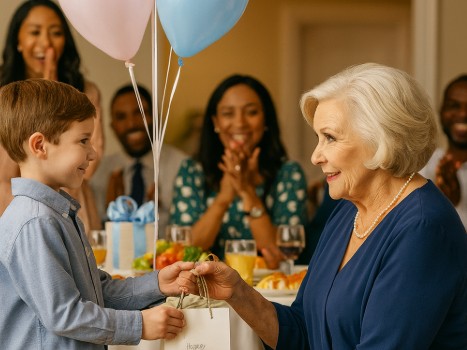
At my sister’s baby shower, my mother sneered, “Well, at least that baby has a father.” My aunt chuckled and added, “Not like her sister’s illegitimate child.” Then my nine-year-old son walked up with a gift bag and said, “Grandma, I brought you something. Dad told me to give it to you.”
I was holding a paper plate with a half-eaten cupcake when my mother’s voice cut through the laughter and the soft clinks of plastic glasses. She stood by the table piled with baby gifts, champagne in hand, smiling like she was offering a toast, and then dropped a line that hit me in the gut in front of the entire room. “At least this baby has a father,” she said, her tone smooth on the surface but sharp underneath.
A few people laughed nervously. Others went quiet. I caught her eye for a second and saw that familiar look she always wore when she thought she’d managed to put me in my place—cold, satisfied, as if she’d proven something about me in public. Before I could respond, my aunt Denise, my mother’s twin-in-mean, laughed loud enough for everyone to hear and added, “Unlike her sister’s bastard child.”
The word hung there like a weight. I froze. The paper plate in my hand bent under the pressure of my grip. I couldn’t breathe. I didn’t move. Eli, my nine-year-old son, had been right behind me, thrilled with the idea of being at his cousin’s baby shower, clutching the little gift bag he’d chosen for Grandma. He heard it all. He didn’t cry. He didn’t run. He didn’t hide. He walked straight toward my mother, small hand holding the bag like it was a shield.
“Grandma,” he said, his voice even and clear, “I got something for you. Dad told me to give you this.”
The room went quiet.
My name is Zara. I’m twenty-eight years old. I’ve been raising Eli alone since he was a baby. His father, Jordan, passed away a year after Eli was born from a sudden heart problem that stole him away. We were young, in love, scared, and trying to build something that made sense in a world that wasn’t always kind to people like us. When he died, I lost more than a partner. I lost a part of myself.
From that day forward, it was just me and Eli. We lived through scraped knees, tight budgets, moves with boxes stacked in the hallway, and the kind of quiet resilience that doesn’t get written about. I worked late, watered down meals, patched old clothes, and kept smiling for him when I felt like crumbling. He saw me struggle. He saw me keep going. He didn’t see weakness. He saw his mom, and that was enough for him. That’s the version of us I carried like armor.
But the people I grew up with didn’t see it the same way. To them, I was always “the mistake.” The girl who got pregnant young. The girl who didn’t do it the “right way.” Marriage, steady job, nice house—that was the template. My younger sister, Kiara, followed it. She waited. She married. She had approval. She had the golden glow of the “good” one. I got the side-eye. I got the whispers. I got the silence that held the message: you are not quite right.
So when Kiara invited us to her baby shower, I showed up. I brought a blanket that I stitched myself over three late nights, pulling thread tight so that each stitch held the kind of love only a mother who’d watched her child grow through grief could understand. Eli picked out the book himself—Love You Forever—because he said the new baby cousin should know how to love their mother, the way he’d learned from me. I wrapped the book carefully, tied the blanket with a ribbon, and hoped, quietly, that maybe this time, something could shift.
The shower was held in a local community hall. Gold balloons hung from the ceiling. A banner that read “Welcome Baby Amara” stretched over the gift table. Kiara was glowing, radiant in that way people talk about when everything around you looks right. She hugged me. She seemed, for a moment, to mean it when she said she was happy we were there. Eli ran toward the snack table, his eyes lighting up at the cupcake display. I watched the room, the smiles that didn’t reach the eyes, the small sideways glances. I’d grown used to fading into the background of their approval; I just hoped Eli wouldn’t have to.
Then my mother stood up. She lifted her champagne flute like she was about to give a toast of praise, and began. She talked about Kiara—how proud she was that Kiara had done everything “the correct way.” She praised the “stable foundation” and the “two-parent family” the new baby would have. I felt the soft tighten of shame starting again in my chest.
Then she looked at me. “At least this baby has a father,” she said, slow and clear, her smile polished like gloss on a page but her meaning jagged.
My stomach dropped. I thought maybe someone would speak up. No one did. Then Aunt Denise, loud and smug, added, “Unlike her sister’s bastard child.”
The room sat like a movie paused. I felt the eyes shift toward me, then slide away. No one—no one—stood. Not Kiara. Not any of the cousins. Silence was the choice. I sat there, burning inside, wanting to lash out, to force them to see what they had just said. But I’d learned over time that if I reacted, they’d take that moment and turn it into a story about me—emotional, overdramatic, unstable—so I stayed frozen.
Then Eli stood. He didn’t ask me. He didn’t hesitate. He took the little gift bag, labeled in his blocky handwriting, To Grandma, and walked through the room like he owned that space. I reached out instinctively. “Baby, don’t,” I whispered.
He looked back at me with his soft brown eyes, shook his head, and kept walking.
He stood in front of my mother, held out the bag, and said, “Grandma, I got something for you. Dad told me to give you this.”
She took the bag, expecting perhaps some small trinket. She opened it. First came a framed photo. Her face shifted when she saw it. The photo was of Jordan and me, taken only weeks before his surgery. We were sitting on a park bench, our hands tangled over my belly, smiling the kind of smile that was full of both fear and hope. He had his arm around me, and I had my hand on his. You could feel the love leaping off the frame.
Below the photo was a folded letter. My mother’s eyes flicked to it. Her expression changed—briefly, there was discomfort, maybe even something like guilt. Then she smoothed it into her practiced neutrality.
It was Jordan’s letter. He had written it before his operation, the one where the risks were real, the one where he had told me to keep going no matter what. I had tucked it away in a shoebox with old Polaroids, the things I didn’t want to touch too often because the grief was raw. I didn’t know Eli had gotten into that box. He must have known. Somehow, he sensed the timing.
My mother read it quietly. The room watched. The letter wasn’t angry. It was love. He talked about how proud he was of me, how scared he was to leave us, and how sure he was I would be strong enough. He’d written that Eli was our miracle. He told me that the world’s definitions didn’t matter—that I was enough, more than enough, and no one had the right to make me feel less.
The weight in the room shifted. Even Aunt Denise had nothing to say. Kiara’s face softened, tears forming at the corners of her eyes. The air stilled.
Then Eli turned toward my mother and said, loud enough for everyone to hear, “My dad loved me. He loved my mom. That means I’m not a mistake.”
It wasn’t a shout. It wasn’t a plea. It was a statement. It landed like a new kind of truth in the space that had been filled with quiet judgments for years.
I stood up. My hands trembled a little, but there was steadiness in my spine I hadn’t felt in a long time. I looked at my mother. I didn’t soften. I didn’t offer peace. “You will never talk about my son like that again,” I said.
Her lips parted. I didn’t let her speak. “You ignored him because you didn’t like how he came into the world. You treated him like a stain. His father loved him. I love him. He isn’t a mistake. He’s the best thing that ever happened to me.”
Kiara was crying quietly now. Her eyes didn’t leave me.
We turned and walked out. No yelling. No second chances. People watched us go—not with pity, but with something that felt like recognition.
That night, back in our small apartment, Eli asked me softly, “Was I doing the right thing?”
“Yes,” I said. “You did something brave. You made them see.”
The next day, my mother texted: That was unnecessary. We could’ve handled it quietly. I didn’t answer. But the ripple had started. My cousin Kayla reached out later. That was powerful. I didn’t know how to help before. You’re an amazing mom.
Kiara called a week later. Her voice was shaky. She said she was sorry for staying quiet. I told her, “I don’t need you to defend me. I need you to stop being quiet.”
Something changed. I stopped trying to disappear in their rooms. I started going to therapy—not because I was broken, but because I wanted to build something that reflected who I really was, not who they tried to label me.
Eli still sat on the edge of the couch and watched me, his hero. He didn’t see weakness. He saw a mom who kept promises, who kept showing up. He is my mirror.
The truth is, I didn’t raise a mistake. I raised a voice. When he stepped forward and gave that letter to the woman who had spent years making me feel less, he didn’t just defend me. He showed me who I was without the filters.